Mölln Water Tower, Water tower in Mölln, Germany.
The Mölln Water Tower is a brick tower built in 1911–1913 to a design by Hans Ritter in Romanesque Revival style, resembling a castle tower. It has a cylindrical shaft and a slightly projecting octagonal tank head with a ring of semicircular windows, topped by a crenellated viewing platform reached by 186 steps. The tower is 36 metres high.
The tower was built between 1911 and 1913 to plans by the Berlin civil engineer Hans Ritter, after Mölln had long drawn its drinking water from numerous decentralised wells. Raw water came from 48-metre-deep wells, was treated in an iron-removal plant and pumped up into the tower. A new 2,500 m³ clean-water tank followed in 1964, but the tower stayed in the network until it was decommissioned in 1981.
The tower's castle-like neo-Romanesque design, with battlements and an octagonal reservoir section, was chosen by Berlin engineer Hans Ritter rather than a plain functional form. Since 1987 it has been a protected monument, and it now houses an exhibition on the region's flora, fauna and history.
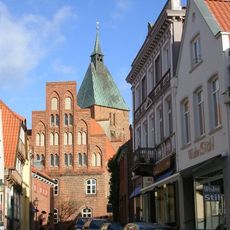
The tower stands in central Mölln and serves as an easily recognizable orientation point in the town. The building is visible from outside at any time and makes a good starting point for exploring the surrounding area.
The tower's steel suspended-bottom tank held about 220 cubic metres of water and was removed after 1981, when the tower left the network. A side stair turret was added so the 186 steps could pass the tank. Since a burst pipe in 2013 caused heavy mould, the tower has been closed again.
The community of curious travelers
AroundUs brings together thousands of curated places, local tips, and hidden gems, enriched daily by 94,617 contributors worldwide.