Herrenkrug Railway Bridge, Railway truss bridge in Magdeburg, Germany.
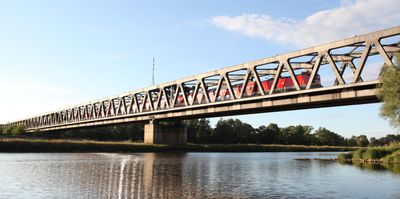
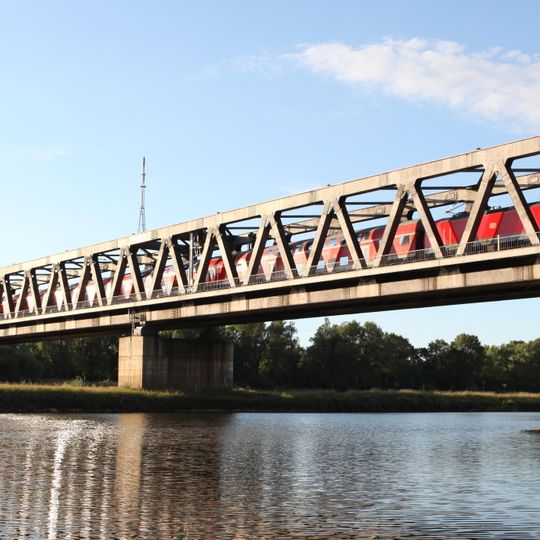
The Herrenkrug Railway Bridge spans the Elbe at kilometre 329.56 on the Berlin–Magdeburg line. The current 680 m double-track structure, built just north of the 1873 bridge and opened on 14 November 1979, has five steel truss spans over the river: a central span of 135.1 m and four side spans of 85.5 m. The eastern floodplain is crossed by a 204.94 m deck bridge with plate girders.
The first bridge here was built between 1869 and 1872 as the Berlin–Magdeburg line was rerouted for Magdeburg's new main station, and it opened on 15 May 1873. In the 1910s up to 125 train pairs crossed it daily. German troops blew it up on 18 April 1945; it reopened on 12 March 1946. A replacement was built just north of the old bridge and entered service on 14 November 1979.
The bridge carries the Berlin–Magdeburg line and was long one of the most important Elbe crossings for east–west rail traffic; in the 1910s up to 125 train pairs used it daily. Its name comes from the Herrenkrug district on the eastern bank. The 1979 replacement stands parallel to the 1873 bridge, whose five 62.8 m main spans were built as Schwedler trusses.
The bridge carries the Berlin–Magdeburg line over the Elbe at kilometre 329.56, with the eastern end at line kilometre 137.370; trains cross at up to 100 km/h, so it is a rail structure, not a walkway. The navigable channel passes under the steel truss, which leaves 6.14 m of clearance at the highest navigable water level. The five piers over the floodplain were rebuilt between April and September 2021.
The 1979 replacement runs parallel to the 1873 bridge on its northern side. Its five Elbe spans use a post-free steel braced truss with the track carried on the lower deck, and the rails sit directly on the bridge structure without a ballast bed, at a track spacing of 4.25 m.
The community of curious travelers
AroundUs brings together thousands of curated places, local tips, and hidden gems, enriched daily by 93,098 contributors worldwide.