Quinter Schloss, Cultural heritage château in Rhineland-Palatinate, Germany
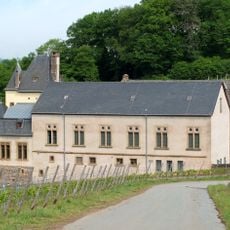
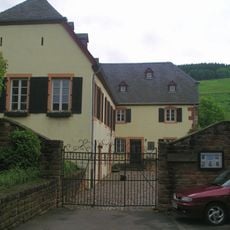
Quinter Schloss is a three-winged baroque palace whose wings enclose a rectangular cour d'honneur, closed on the fourth side by a low wall with a Gothic-style iron grille from 1825, whose gate pillars carry two cast-iron griffins. The two-storey building has rendered rubble masonry with red stone trim and a mansard roof with dormers; unusually, it lacks a projecting central pavilion. The garden facade has 17 axes, with a balcony supported by atlas pilasters and a round gable flanked by allegorical figures of agriculture and industry, with Chronos in the tympanum and Prometheus with a torch on top.
Franz Pidoll, a former Lorraine officer, founded an ironworks on the Quintbach with his father-in-law Jean Pierre de Thier in 1683; Emperor Charles VI ennobled him as "Pidoll von Quintenbach" in 1714. The present palace was built around 1760 as the residence and administration building of the Quinter Hütte, possibly to plans by court architect Johannes Seiz. French revolutionary troops expropriated the family in 1794 and closed the works, which resumed in 1808.
The name Quint comes from the Latin ad quintum lapidem, "at the fifth milestone" of the Roman road from Trier to Andernach. The palace was the residence and administrative seat of the Pidoll family, owners of the Quinter Hütte ironworks founded in 1683; Emperor Charles VI raised Franz Pidoll to hereditary nobility as "Pidoll von Quintenbach" in 1714. The sculpted Pidoll coat of arms still sits on the courtyard facade.
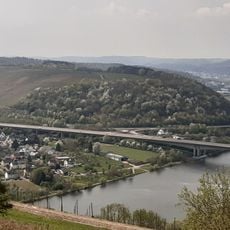
The palace is a private property and can only be viewed from the outside; interior visits are not possible. It stands on the left bank of the Moselle in Trier-Quint, and the garden front with its broad outdoor staircase faces the park, where a ginkgo, a plane tree, a swamp cypress and a lily magnolia are protected as natural monuments.
The south facade's central gable carries allegorical figures of agriculture and industry, with Chronos in the tympanum and Prometheus holding a torch on top. The sculpture is attributed to Ferdinand Tietz. In the park, a ginkgo, a plane, a swamp cypress and a lily magnolia are protected as natural monuments.
The community of curious travelers
AroundUs brings together thousands of curated places, local tips, and hidden gems, enriched daily by 93,467 contributors worldwide.