Kluterthöhle, Limestone cave system in Ennepetal, Germany.
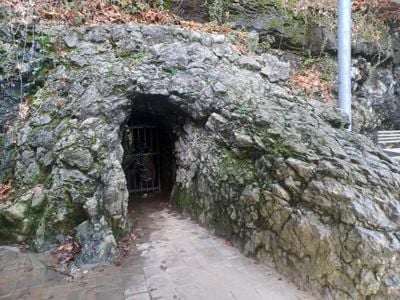
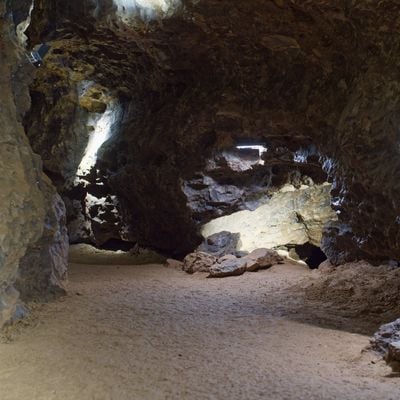
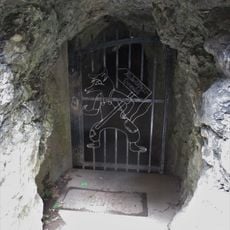
The Kluterthöhle is a cave system in Ennepetal with 8,852 metres of passages, more than 300 galleries, underground lakes and streams across roughly 400 by 200 metres. Its entrance is set into a rough grey rock mound, where an arched opening bordered by mossy stone blocks leads to a barred metal gate. Much of the interior is worn by centuries of use, so dripstone formations survive only in the least accessible parts.
The Kluterthöhle formed about 370 million years ago, when a roughly 12.5-metre-thick layer of reef limestone was deposited in the Devonian sea. The cave itself was created later by the leaching of this northward-dipping limestone. In 1937 the Klutertberg with the Bismarckhöhle was designated a nature reserve for its cave fauna, and in 2019 the cave was recognised as a Nationales Naturmonument.
The cave has served as an excursion destination since the Enlightenment. In the Second World War it sheltered up to 4,000 people from air raids, and a children's carousel was even set up in the neighbouring Bismarckhöhle to shorten the wait during bombing nights.
The pathways through the cave are walkable, but there are stairs and uneven areas to watch for. Visitors should wear sturdy shoes and bring a light jacket, as it is cool and sometimes damp underground.
Since the mid-1950s the cave has been used for lung cures; its constant 10 °C air draws asthma sufferers. In 1937 the Klutertberg with the Bismarckhöhle was already protected for its cave fauna, when 150 animal species were known there. On 2 April 2019 the cave was recognised as Germany's fourth Nationales Naturmonument.
The community of curious travelers
AroundUs brings together thousands of curated places, local tips, and hidden gems, enriched daily by 94,075 contributors worldwide.