Schloss Wolfsbrunn, Art Nouveau villa in Hartenstein, Germany
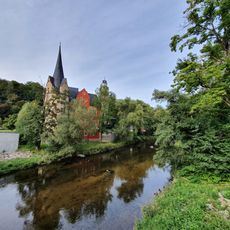
Schloss Wolfsbrunn is an L-shaped villa built 1911–1914 for mining entrepreneur Karl Georg Wolf to designs by Munich architect Emanuel von Seidl, in Reformarchitektur style with echoes of South German Baroque. Its base storey and window surrounds are clad in red porphyry, and a cartouche sits above the main entrance. It stands in a six-hectare park with a square fountain whose turtle spouts face a red porphyry well crowned by a seated wolf.
A mining entrepreneur commissioned architect Emanuel von Seidl to design this residence, completed in 1911 as a statement of industrial wealth. Following World War II, the building served as a school under the German Democratic Republic before becoming a hotel in 1997.
The name comes from the octagonal red porphyry fountain at the courtyard approach, where a seated wolf figure sits under four columns and a solid tracery dome. In the Herrenzimmer hang Ludwig von Herterich's portraits of Goethe, Mozart, Beethoven and Richard Wagner; in the Blue Salon Julius Diez painted the ceiling with Diana and the twelve zodiac signs.
The 6-hectare park is a Musterpark of the Free State of Saxony, with lawns and two fountains: a square one with turtle spouts and the octagonal red porphyry Wolfsbrunnen crowned by a seated wolf figure, placed at the courtyard approach. The house is a hotel, so visits concern the grounds and the building's exterior; the L-shaped plan and red porphyry base are best seen from the park side.
The castle served as a youth school for several decades under the German Democratic Republic, a fact that often surprises visitors. This period left visible traces in the interior that careful observers can still notice today.
The community of curious travelers
AroundUs brings together thousands of curated places, local tips, and hidden gems, enriched daily by 93,998 contributors worldwide.