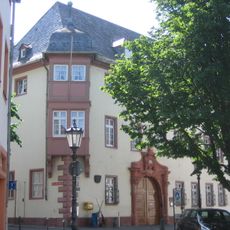
Gau Gate, Cultural heritage gate in Mainz, Germany.
The Gau Gate is a surviving baroque show facade of red sandstone, the outer face of a gate built in 1670 as part of Mainz's bastionary fortifications. The gate itself was demolished in 1896; the facade was re-erected near its original site in 1998. Its triangular gable holds a sculpture group of Saint Martin on horseback dividing his cloak with two beggars, one crouching and one with a wooden leg and crutch. Below the gable, an empty coat-of-arms shield sits above the date 1670.
The gate was built in 1670 when Mainz was expanding its defenses and growing as a key trading hub on the Rhine. It was constructed during a period of major urban development when controlling access to the city was essential.
The name comes from Gau, an Old High German word for countryside, as the gate linked the city to the surrounding land. From 1671, Mainz's Jewish ordinance required Jews to enter and leave the city only through this gate. The surviving outer facade, with its Saint Martin group, was saved from demolition only through protests by Mainz citizens.
Only the outer baroque facade survives, re-erected in 1998 near its original site; it stands as a freestanding monument, not a gate you can walk through. The gable figures are replicas since 2002, the originals being in the Landesmuseum Mainz. Look for the empty electoral coat-of-arms shield and the date 1670 above the arch.
The surviving baroque facade was saved only through protests by Mainz citizens, then moved three times: to the courtyard of today's Frauenlob-Gymnasium, to the green area at Fichteplatz from 1962, and back near its original site in 1998. Since 2002 the St Martin group on the gable is a replica; the originals are in the Landesmuseum Mainz.
The community of curious travelers
AroundUs brings together thousands of curated places, local tips, and hidden gems, enriched daily by 93,647 contributors worldwide.