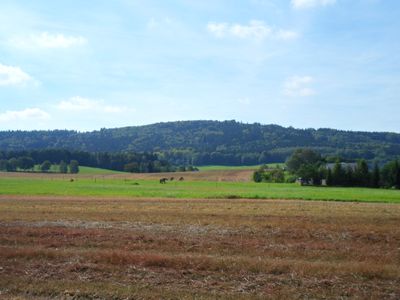
Hochstein, Mountain summit in Bautzen District, Germany.
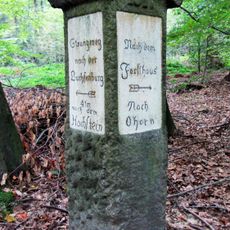
Hochstein is a mountain in the Upper Lusatian Highlands with an elevation of 448.9 meters and rocky cliffs at its summit. The area includes several marked hiking trails, including the Kammweg between Kleindehsa and Großpostwitz marked with blue blazes.
The summit rocks were carved with an inscription in 1769 by Gottfried Ekart, rector in Pulsnitz. In 1825 Dr. Johann Gottfried Bönisch interpreted the summit rock as a sacrificial altar to the goddess Ostara and linked the name Sibillenstein to priestesses who foretold the future. A bronze battle axe found 150 m from the rock in 1886 supports prehistoric use of the site.
Residents called the summit rock Teufelskanzel (Devil's Pulpit) and the northern platform Teufels Tischblatt, where spirits were said to dance in a deepened circle. The roughly 3-metre bowl-shaped hollow was regarded as an offering bowl in which the devil measured grain and turned cheats' heads. A large stone below the north crag is called the Reitpferd.
The blue blazes of the Kammweg hiking trail help with navigation, and hikers should wear sturdy footwear as the routes cross steep sections and rocky terrain. Carrying a map or GPS device is useful for tracking the various routes through the highland area.
The summit's northern rock platform, about 3 metres across, is a bowl-shaped hollow called the Devil's Table by locals, who said spirits danced in it and the devil measured grain there. A single large boulder below the north crag is known as the Sibyl's riding horse.
The community of curious travelers
AroundUs brings together thousands of curated places, local tips, and hidden gems, enriched daily by 94,393 contributors worldwide.