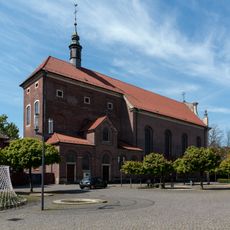
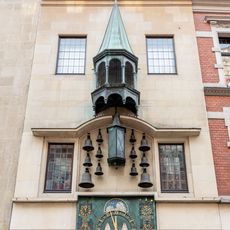
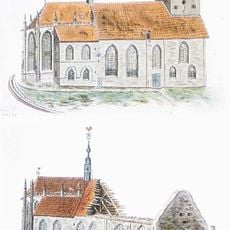
St. Ludgeri, Gothic parish church in Münster-Mitte, Germany.
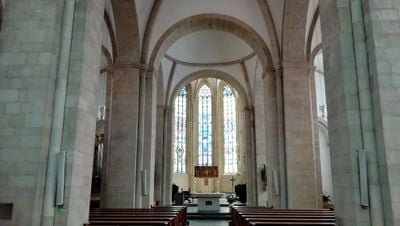
St. Ludgeri is a church in Münster-Mitte whose construction began in 1173 and was completed around 1220. It is the first example of the Westphalian stepped-hall church type, with a central crossing tower that received a Gothic storey after the 1383 fire. The interior has light stone pillars, rounded arches and a vaulted ceiling; the choir windows are pointed, and a wooden panel with painted figures stands behind the altar.
St. Ludgeri was first documented in 1173, when Bishop Ludwig I of Wippra endowed it with the manor of Wargebeke; construction was completed around 1220. A collegiate foundation existed by 1185, and the church was rebuilt after a town fire in 1383, when the small choir was replaced by a larger, higher one and the crossing tower gained a Gothic storey. The two west towers were added only in 1876. The collegiate foundation was dissolved on 2 December 1811.
The church is named after Liudger, the missionary who founded Münster. The tympanum of the west portal, added in 1861, shows Liudger enthroned between Heriburg of Nottuln and the blind bard Bernlef, whom Liudger healed. The south portal bears the inscription "V.D.M.I.E. Anno Domini 1537", a Protestant motto from 1 Peter 1:25.
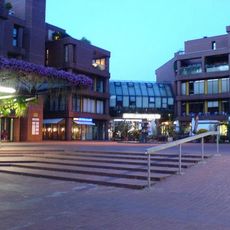
The church sits at the edge of the pedestrian zone and can be reached from Ludgeristraße, Königsstraße, and Verspoel. Nearby Marienplatz offers shaded seating where visitors can rest before or after their visit.
The church keeps a wooden crucifix carved in 1929 that lost both arms in a 1944 bombing. It was left unrestored, and where the arms would be the cross bears the inscription "ICH HABE KEINE ANDEREN HAENDE ALS DIE EUEREN". Below hang medallions of Nicolaus Steno and Edith Stein.
The community of curious travelers
AroundUs brings together thousands of curated places, local tips, and hidden gems, enriched daily by 94,191 contributors worldwide.