Schwedenschanze, 7th-century hillfort in Groß Thun, Stade, Germany
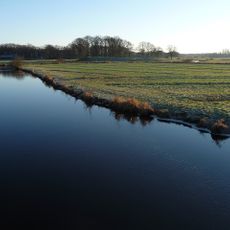
Schwedenschanze is the remnant of an early medieval hillfort on a slightly raised sand island on the right bank of the Schwinge, about 6 km from the Elbe. Its oval rampart measures roughly 170 × 100 m, still stands up to 5.5 m high and is 20–30 m wide at the base; the gap on the southwest side is modern. The wood-and-earth wall was topped by a palisade and covered with grass sods.
The rampart was built around 670, as shown by a beam from a tree felled in 673, making it one of the few 7th-century castles between the Elbe and the Rhine. It was inhabited until about 900, when the castle on the Stader Spiegelberg probably took over its role. Excavations in 2007 and later found settlement traces, ovens and a wooden quay wall by the Schwinge.
The name Schwedenschanze is a misnomer: it was long assumed the visible ramparts were thrown up by Swedish troops during the Thirty Years' War in the 17th century. In fact the site is about 1,000 years older, dated by a beam from a tree felled in 673. Visitors today see a grass-covered earthwork in the Groß Thun district, on the right bank of the Schwinge.
The rampart lies on the right bank of the Schwinge in Groß Thun, about 6 km from the Elbe, on a slightly raised sand island. The southwestern gap in the wall is modern, so enter there. The wall still stands up to 5.5 m high and is 20–30 m wide at its base.
The name Schwedenschanze is a misnomer: the rampart was long thought to be a 17th-century Swedish earthwork from the Thirty Years' War, but a beam from a tree felled in 673 shows it is about 1,000 years older. Excavations in 2008 also brought to light early medieval oars, the first of their kind found in Germany.
The community of curious travelers
AroundUs brings together thousands of curated places, local tips, and hidden gems, enriched daily by 93,597 contributors worldwide.