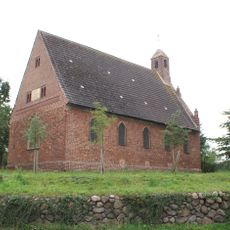
Gertrudenkapelle, Gothic chapel in Wolgast, Germany.
Gertrudenkapelle is a brick Gothic chapel in Wolgast designed to mirror the Church of the Holy Sepulchre in Jerusalem. The interior features a central support column that holds a star-vaulted ceiling, creating a distinctive twelve-sided space built entirely of brick.
The chapel was built around 1420 as part of a hospital outside Wolgast's walls, dedicated to Saint Gertrude of Nivelles, patron of pilgrims. A Pomeranian duke is said to have founded it after a pilgrimage to the Holy Land, possibly Wartislaw IX in 1418/1419, though this is not documented. After the Reformation in 1534 it became a cemetery chapel; it survived the 1713 burning of the town and served St. Petri's congregation until 1718.
The chapel's name recalls Saint Gertrude of Nivelles, patron saint of pilgrims and travellers, to whom the hospital chapel was dedicated. After the Reformation was introduced in the Duchy of Pomerania in 1534, the building served as a cemetery chapel, and wealthier Wolgast citizens were buried in the surrounding Gertrudenfriedhof. Since 2003 a support association has worked for its restoration and later cultural use.
The chapel stands south of Chausseestraße (Bundesstraße 111) on the Alter Friedhof, outside the former town walls, so it is reached on foot from the old town. The building can be viewed on request; the surrounding grounds were renovated in 1995. Since 2003 a support association has worked on its restoration and later cultural use.
The chapel's twelve-sided plan imitates the Church of the Holy Sepulchre in Jerusalem, with eleven buttresses and a stair turret where the twelfth would stand. Its Totentanz, a dance-of-death painting made around 1660 for Wolgast Castle, hung here around 1700 before moving to St. Petri Church, where it is shown today.
The community of curious travelers
AroundUs brings together thousands of curated places, local tips, and hidden gems, enriched daily by 94,353 contributors worldwide.