St. Michael, Medieval Brick Gothic church in Krummin, Germany
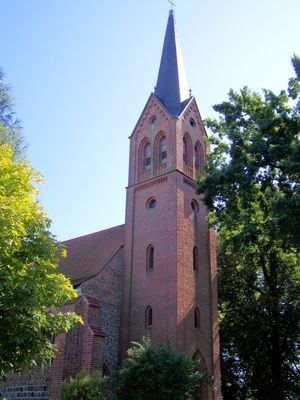
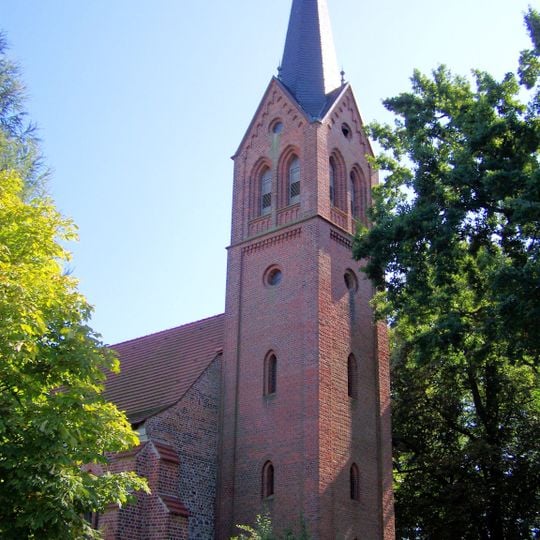
St. Michael is a red brick church with a tall square tower on the right, topped by a steep, dark, slender spire. The tower has narrow round-arched windows and circular openings in vertical rows. A brick gable with pinnacles separates the tower from the lower nave, which has a sloping tiled roof and arched windows.
A church dedicated to St. Michael existed at Krummin by 1230, when Duke Barnim I and his mother Miroslawa granted it the tithes of neighbouring villages; the first priest was Goswin. The present brick church was built around 1260–1270 as the monastery church of a Cistercian nunnery founded around 1302. After the Reformation it became a parish church again in 1563, and the west tower was rebuilt in 1855–1857 to designs by King Frederick William IV of Prussia.
The church is dedicated to St. Michael, and the village of Krummin is first recorded in 1230 under the name Crominino in a document confirming the church's tithes. After the Reformation, St. Michael became a parish church again in 1563. The former Cistercian convent was visited by Duke Johann Friedrich and its archive, including original charters, was moved to Wolgast in 1562.
The church stands in the village of Krummin on the island of Usedom, in the northwest of Mecklenburg-Vorpommern. The west tower, rebuilt from 1855 to 1857 to designs by King Friedrich Wilhelm IV, is the landmark to aim for when approaching. The nave and polygonal choir are surrounded by a churchyard whose sloping ground required buttresses, added in 1734 and 1780.
The church bell bears an inscription connected to Pastor Wilhelm Meinhold, a 19th-century author who gained fame for his novel about a legendary witch story from this region. This link between the building and his literary work makes the church an interesting place for those drawn to history and storytelling.
The community of curious travelers
AroundUs brings together thousands of curated places, local tips, and hidden gems, enriched daily by 93,990 contributors worldwide.