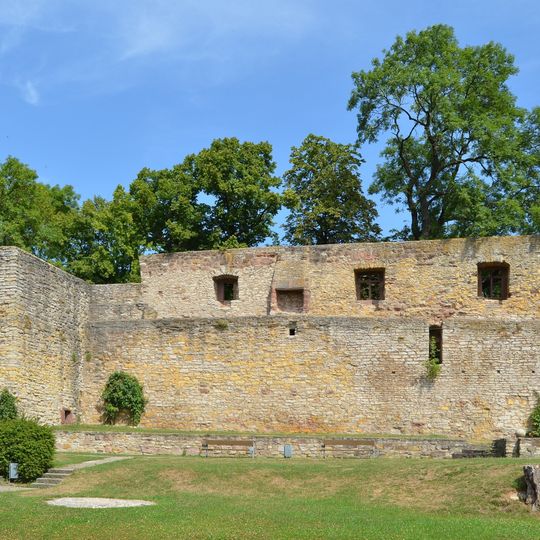
Heldenburg, Castle ruin in Salzderhelden, Einbeck, Germany
Heldenburg is a castle ruin on a hilltop with preserved stone remains of a four-wing building surrounding a square courtyard. The site shows traces of a residential palace, chapel, storage cellars, and a distinctive tower with an interior spiral staircase.
The castle was probably built in the 13th century by the Counts of Dassel or the Welf dukes. In 1291 it passed to Duke Henry Mirabilis of Grubenhagen, who made it his main residence and died there in 1322. It remained a Grubenhagen residence until 1596, when the line died out; after inheritance disputes it passed to the Lüneburg Welfs in 1617 and was abandoned from the 18th century.
The name likely derives from "Halde", meaning the castle "on the slope". In 1361 Duke Albrecht I of Braunschweig-Grubenhagen used a seal with a horse walking to the right at Salzderhelden; this later became the Saxon Steed of Lower Saxony's coat of arms. Modern frescoes in the Burgschänke at the entrance depict the castle's history.
The ruins are accessible via marked pathways with information panels throughout the site. Visitors should note that path conditions vary by season and sturdy footwear is recommended for exploring the uneven stone surfaces.
In 1365, Landgrave Frederick of Thuringia besieged the castle with some 18,000 men. The defenders used a cannon, and the attackers suffered such heavy losses that they soon withdrew. According to the source, this was the first case in German lands of a castle being defended with a gun.
The community of curious travelers
AroundUs brings together thousands of curated places, local tips, and hidden gems, enriched daily by 93,752 contributors worldwide.