Lauffen barrage, Hydroelectric barrage on Neckar River in Lauffen am Neckar, Germany.
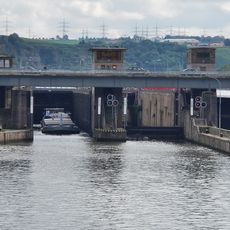
Lauffen barrage is a hydroelectric structure on the Neckar River that uses concrete walls and mechanical gates to control water levels. The installation features a lock system allowing boats to navigate varying water heights while generating power from the flowing water.
Construction of the left lock chamber, power plant, weir and the downstream navigation channel was commissioned in 1938, with completion planned for December 1940. Wartime conditions halted the work; the remaining tasks were awarded in 1948 and the lock opened to traffic in 1951. The right lock chamber followed in 1962 after the second construction phase. From the Rhine, the barrage is the 14th installation of its kind.
The lock canal cuts a 0.8 km channel through Lauffen am Neckar, and the B 27 road bridge crosses the Neckar directly below the lock. From the Rhine, this is the 14th barrage on the river. The right chamber's lower gate was upgraded in 1982 and its upper gate in 1986, while its wall concrete, drives and electrical equipment still date from the original construction.
The barrage sits at the upper end of the roughly 0.8 km Lauffener Kanal, with the double lock on the right bank and the power plant on the left; the B 27 road bridge crosses the Neckar just below the lock. The left chamber's concrete walls date from 1951 and were milled 0.40 m deep and refaced between 2013 and 2018, while the right chamber keeps its original wall concrete, drives and electrical equipment.
The lock gate system can bridge height differences of several meters in a short time, working like a liquid elevator for cargo ships. This technical feature allows inland vessels to navigate the entire river without interruption.
The community of curious travelers
AroundUs brings together thousands of curated places, local tips, and hidden gems, enriched daily by 93,867 contributors worldwide.