Salzaspring, Karst spring in Nordhausen, Germany
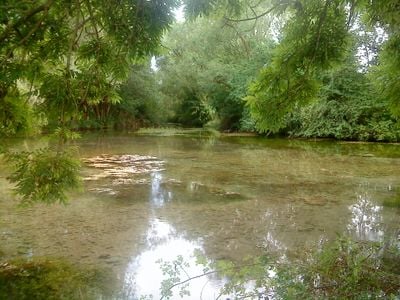
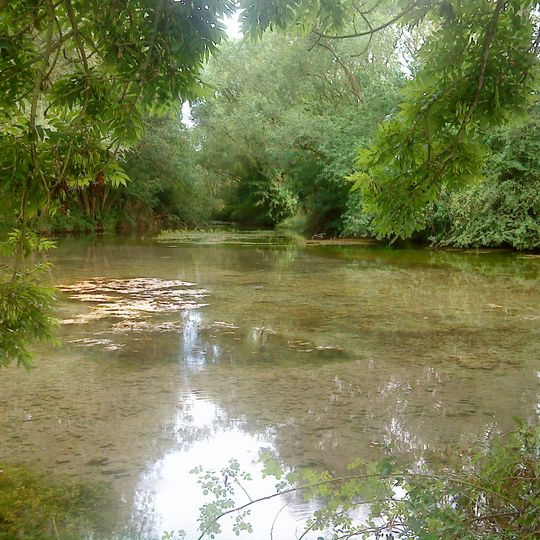
Salzaspring is a karst spring between the Salza and Krimderode districts of Nordhausen, at the southern edge of the Harz. Its main outlet forms a pond up to 70 cm deep with an average discharge of 400 litres per second; smaller outlets called Euter, Stiefel, Tabaksbeutel and Wanne feed the same pond. The separate Grundloses Loch, a circular collapse doline 3.5 m deep with blue-green water, drains directly into the Salza.
The spring is the source of the Salza, a 5.6 km stream that runs parallel to the Zorge and empties into the Helme at Niedersalza. Its catchment is thought to reach as far as Tettenborn, and the flow of the Wieda and Zorge appears in the spring's discharge about a month later. The origin of the water has never been scientifically proven.
The names of the smaller outlets — Euter (udder), Stiefel (boot), Tabaksbeutel (tobacco pouch) and Wanne (tub) — come from the shapes locals saw in the rock and water. The separate Grundloses Loch, a round collapse doline 3.5 m deep with blue-green water, takes its name, "bottomless hole", from the belief that it had no floor.
The site is easily accessible on foot and can be visited year-round. The water is cold and the surroundings remain natural, so wear appropriate clothing and sturdy shoes.
The subsidiary outlets carry folk names: Euter (Udder), Stiefel (Boot), Tabaksbeutel (Tobacco Pouch) and Wanne (Tub). All of them feed the main spring pond, while the Grundloses Loch, a circular collapse doline 3.5 m deep with blue-green water, drains straight into the Salza.
The community of curious travelers
AroundUs brings together thousands of curated places, local tips, and hidden gems, enriched daily by 95,569 contributors worldwide.