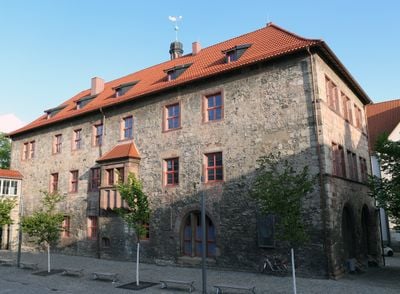
Old town hall, Renaissance town hall in Nordhausen, Germany
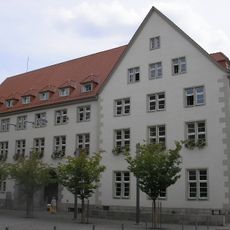
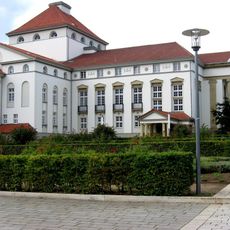
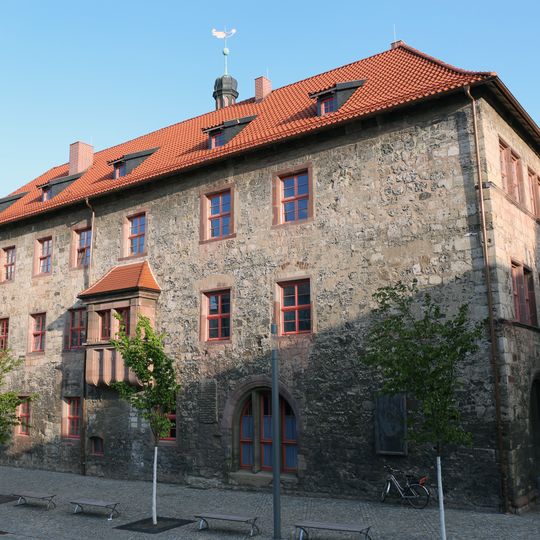
The Old Town Hall is a Renaissance-style administrative building located in the historic center of Nordhausen. Its design incorporates traditional Germanic architectural features characteristic of early 17th-century construction.
A town hall on this site was first documented in 1360; repairs are recorded for 1562, and the present Renaissance building was erected between 1608 and 1610. In 1524 the council became patron of all churches in Nordhausen by edict, introducing the Reformation. During the April 1945 air raids the building burned down to its foundation stones; reconstruction was completed in 1952.
The stone coat of arms tablet above the eastern entrance, once mounted on the churchyard wall, shows in Latin script the legend that Emperor Theodosius II founded the city in 410. In front of the building stands a copy of the Nordhausen Roland, first mentioned in 1411, a symbol of freedom, power and jurisdiction; the original of 1717 is kept in the New Town Hall opposite.
The Old Town Hall stands at Markt 1 in the centre of Nordhausen, with the New Town Hall directly opposite. The Roland figure is at its south-western corner, and a memorial column in front of the entrance recalls the air raids of 3 and 4 April 1945. The building is used today for cultural and community meetings.
The Roland in front of the hall is a 1992 copy; the 1717 original, which lost its pelican group on the canopy in the April 1945 raids, stands in the foyer of the New Town Hall. It is the only Roland in a former free imperial city and the oldest of Germany's five wooden examples.
The community of curious travelers
AroundUs brings together thousands of curated places, local tips, and hidden gems, enriched daily by 93,935 contributors worldwide.