Margarethenkirche, Lutheran church in Gotha, Germany
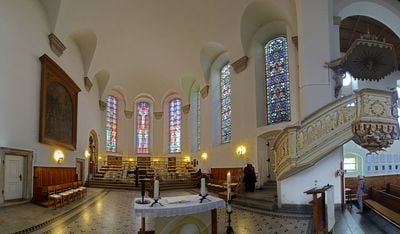
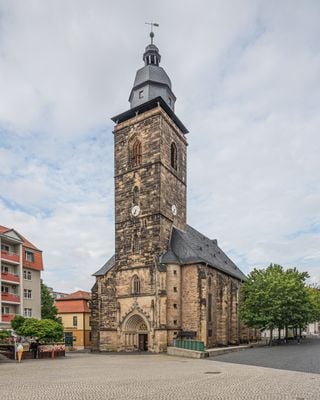
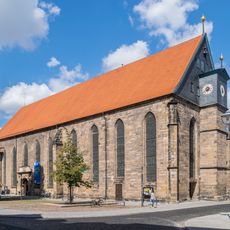
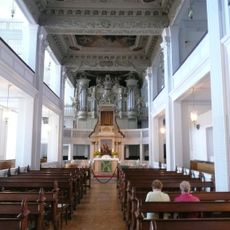
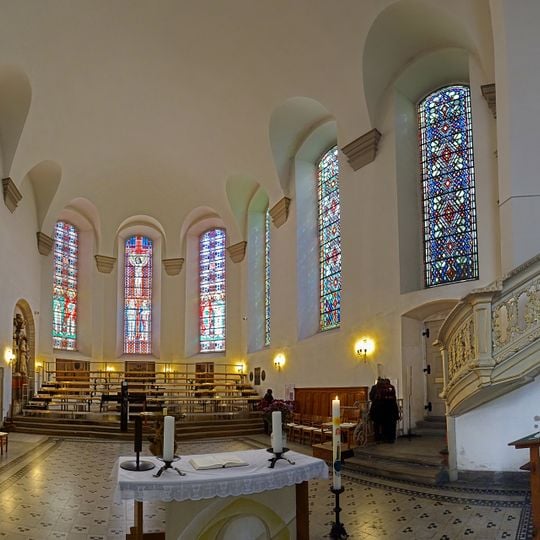
Margarethenkirche is a late-Gothic hall church on Gotha's Neumarkt, first mentioned in 1064 and rebuilt from 1494 on the foundations of a Romanesque basilica. Its square stone tower, completed in 1542, carries a clock and a multi-tiered domed roof; the interior has a white vaulted ceiling, a raised wooden pew platform, and a curved stone staircase with carved balustrade.
First mentioned in 1064, the church was rebuilt from 1494 as a late-Gothic hall church on the foundations of a Romanesque basilica. In 1522 pastor Johann Langenhan preached the Gospel here, making it Gotha's first Evangelical-Lutheran church; Friedrich Myconius organised the Reformation in the city from 1524. The tower was completed in 1542, the interior refitted in Baroque style in 1725–1727, and after a 1944 air mine destroyed it, it was rebuilt in 1952–1955.
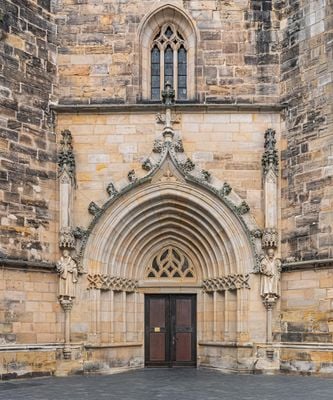
The name recalls Saint Margaret, to whom the medieval church was dedicated. Since 1522, when pastor Johann Langenhan preached the Gospel here, the parish has been the first Evangelical-Lutheran congregation in Gotha. Sculptures of Luther and Melanchthon, carved in 1904 by Christian Behrens, flank the Gothic "Brautportal" (bridal portal).
The church is centrally located in Gotha and accessible on foot from the historic city center. Visitors should check service times before visiting, as this may affect access to the building.
Under the chancel lies the ducal vault where Duke Ernst the Pious was buried in 1675, the first of the House of Saxe-Gotha-Altenburg; until the Friedenstein crypt was finished in 1680, his wife Elisabeth Sophia and several children who died young were also interred here. Duke Frederick III, who died in 1772, rests in the church as well.
The community of curious travelers
AroundUs brings together thousands of curated places, local tips, and hidden gems, enriched daily by 93,860 contributors worldwide.