Burg Grimmenstein, Medieval castle in Gotha, Germany
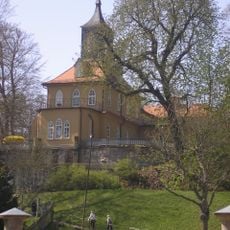
Burg Grimmenstein is a medieval castle on a hilltop at the edge of Gotha, in the state of Thuringia. It is made up of an upper section built directly on bare rock and a lower section that runs along the slope of the hill.
Burg Grimmenstein was probably founded in the 11th century and is first documented in 1215, when it guarded the Via Regia and served as a seat of the Thuringian landgraves Albrecht and Balthasar. In 1526 the Torgau League was signed here, and the castle was later modernised as a Protestant stronghold. After the 1547 defeat at Mühlberg it was slighted, but rebuilt from 1552; in 1567 it was razed after a three-month siege.
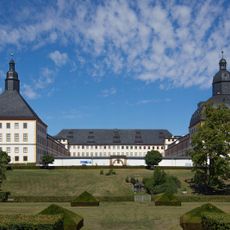
The castle gave its name to Gotha's later residence: the Renaissance portal of the castle chapel, dated 1553, was saved before the demolition and built into Schloss Friedenstein, where parts of the framing scrollwork date from 1644. In the palace courtyard the well and well house are also remains of Grimmenstein.
The castle itself no longer stands; its remains lie beneath Schloss Friedenstein, built on the same site from 1642. Visitors can see surviving parts of the Grimmenstein fortification in the Friedenstein complex: sections of the underground casemates, the well and the well house in the courtyard, and the Renaissance portal of the castle church, reused in the later building.
The castle no longer exists above ground: after its surrender on 14 April 1567, the fortress was razed by 23 June 1567 and the site was used only as pasture until Schloss Friedenstein was built in 1642. Surviving fragments include the castle church portal, later reused at Friedenstein, and parts of the underground casemates, the well and the well house in the palace courtyard.
The community of curious travelers
AroundUs brings together thousands of curated places, local tips, and hidden gems, enriched daily by 92,638 contributors worldwide.