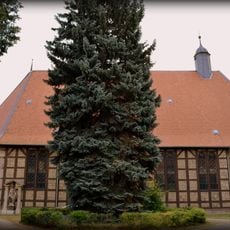
St. Andreas, Cultural heritage monastery in Halberstadt, Germany
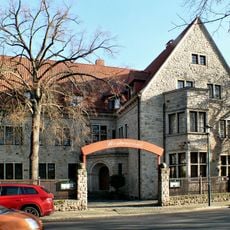
St. Andreas is a Franciscan monastery in Halberstadt featuring medieval architecture with stone walls, pointed arches, and covered walkways. The complex centers around an open courtyard that follows the traditional monastic layout.
Founded around 1223, still during the lifetime of St Francis, the Halberstadt friary is among the earliest Franciscan houses in Germany. The first guardian was Brother Rodeger, a confidant of St Elizabeth of Thuringia; Count Heinrich von Reinstein gave the friars a larger building in 1246, and in 1289 his son built the monastery and the Gothic church of St Andreas. It survived the Reformation as the only house of the Saxonia province, was dissolved in 1814 under secularisation, and was reoccupied by Franciscans from 1920 until 2020.
The street outside was called Bi de Barvoten, "at the Barefooted", after the friars. In the 15th century the convent fostered intense veneration of Saint Anne, with an Anne confraternity and its own side chapel at the church entrance; the tailors' guild endowed an altar there in 1466. The friars ran a parish school and fed the poorest children.
The monastery on Franziskanerstraße was given up by the Franciscans in 2020, so there is no religious community to visit today. The site lies in central Halberstadt, near the cathedral square; the street name Bi de Barvoten, later Franziskanerstraße, recalls the barefoot friars. Check locally before planning a visit, as the former convent is not a regular tourist opening.
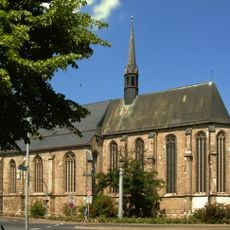
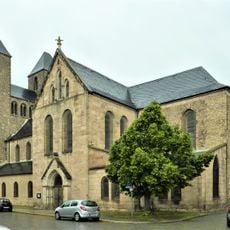
The Gothic church of St. Andreas was built as a three-aisled hall church with a three-bay choir ending in a five-eighth close, its walls faced with sandstone ashlars. Its founder, Count von Reinstein, was buried inside in 1314 wearing the Franciscan habit. The convent was the only house of the Saxon Franciscan province to survive the Reformation-era closures.
The community of curious travelers
AroundUs brings together thousands of curated places, local tips, and hidden gems, enriched daily by 93,858 contributors worldwide.