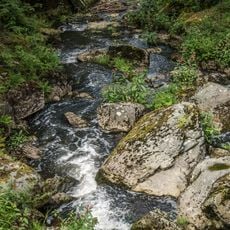
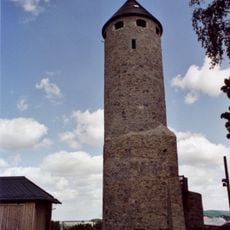
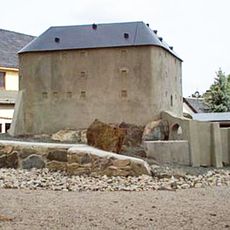
Mundloch, Show mine and architectural heritage monument in Lichtenberg, Germany.
The Friedrich-Wilhelm-Stollen is a show mine near Lichtenberg whose adit runs 975 m almost beside the St 2196 road toward Blechschmidtenhammer, ending at the mouth near the Selbitz at the exit of the Höllental. Alexander von Humboldt planned it in 1793; construction took until 1831. Visitors walk about 200 m of the passage; a collapse blocked the rest until 2019, when it was broken through.
The adit was planned in 1793 by Alexander von Humboldt, then chief mining officer in nearby Steben, and completed in 1831 after 38 years of work. It reached 975 m and was named after Prussian king Friedrich Wilhelm II, who reigned when construction began. It drained neighbouring mines, above all the Lichtenberg Friedensgrube, while iron and copper ore were extracted. Mining stopped in 1857; about a century later fluorite was mined for roughly ten years.
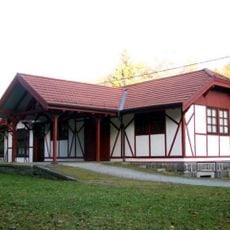
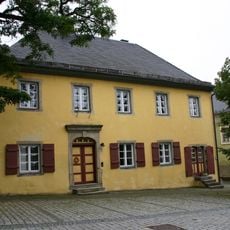
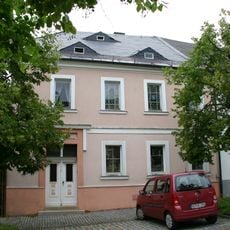
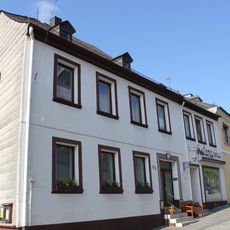
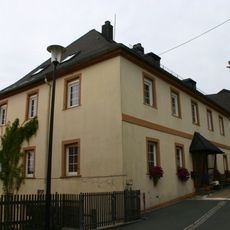
The tunnel is named after King Friedrich Wilhelm II of Prussia, who reigned when construction began in 1793, as the region belonged to Prussia with the Principality of Bayreuth from 1791 to 1806. Since mining stopped in 1857, the Zechenhaus served as an inn, and the adit mouth was used for a time as its rock cellar. The inn has been closed since autumn 2023.
The entrance sits west of the former Zechenhaus, now a closed inn, right by the Staatsstraße 2196 near the Selbitz at the mouth of the Höllental. About 200 metres of the 975-metre adit are open to visitors; guided tours run from 1 April to 31 October. The temperature inside stays around 8 °C, so bring a warm jacket and sturdy shoes.
The tunnel walls clearly show marks from the tools miners used to break the stone, letting you see traces of daily work. Such hand-made marks are rarely preserved so well, giving you a direct sense of human effort and struggle.
The community of curious travelers
AroundUs brings together thousands of curated places, local tips, and hidden gems, enriched daily by 93,942 contributors worldwide.