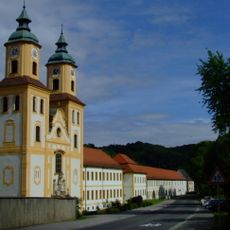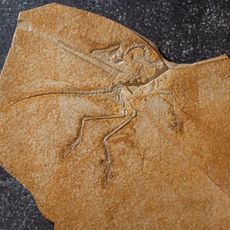
Willibaldsburg, Medieval castle in Eichstätt, Germany.
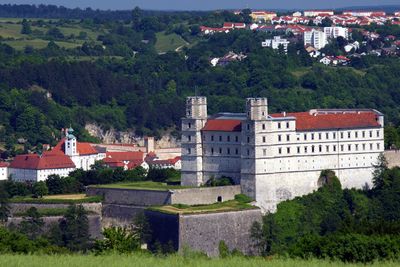
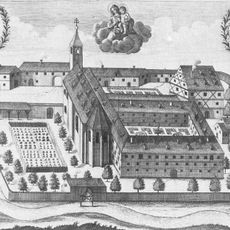
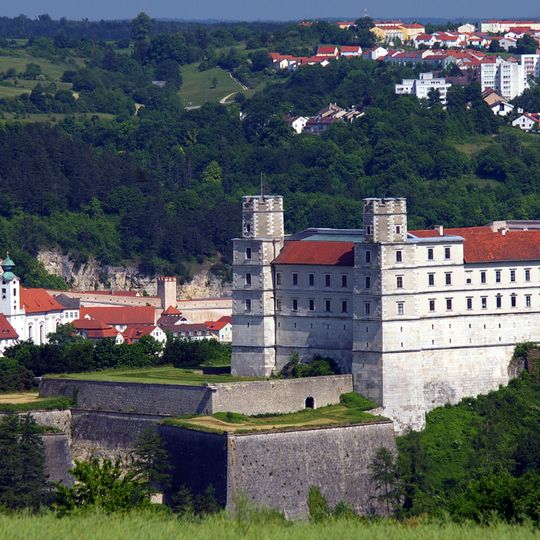
Willibaldsburg is a spur castle begun around 1353 on the Willibaldsberg, a ridge 464 m above sea level above the Altmühl valley west of Eichstätt's Old Town. The complex runs about 420 m in length. Its long main range has a steep red-tiled roof and two tall square corner towers facing the valley, with a shorter square tower to the left; a massive battered stone bastion with sloped retaining walls projects in front. The Gemmingenbau, planned from 1609 by Augsburg master builder Elias Holl, received its two-tower facade from 1629 under Hans Alberthal and Martin Barbieri.
The first fortification rose around 1070, then underwent major expansion in the 14th century under the prince-bishops who transformed it into their official residence. This renovation established it as the primary stronghold of Eichstätt's spiritual rulers.
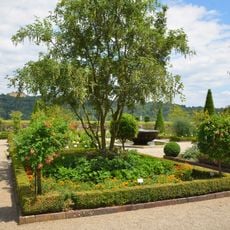
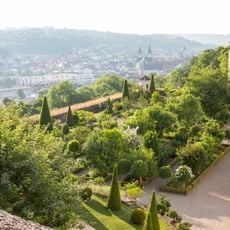
The name comes from Willibald, the first bishop of Eichstätt (c. 700 – c. 787), who gave the hill its name. Under Johann Konrad von Gemmingen the castle held a botanical garden whose plants were recorded by curator Basilius Besler in the Hortus Eystettensis of 1613. The reconstructed bastion garden today follows that 17th-century planting.
The fortress is reached on foot via paths up the hillside, and a half day is enough to explore the entire complex including the museums. Sturdy shoes are advisable since the old staircases and walkways are steep and uneven in places.
The reconstructed bastion garden on the Willibaldsburg revives the Hortus Eystettensis, the botanical garden Bishop Johann Konrad von Gemmingen laid out after 1595. Its curator Basilius Besler published the plant catalogue in 1613, and engravings from it were supplied by Wolfgang Kilian. The garden was reinaugurated in 1998.
The community of curious travelers
AroundUs brings together thousands of curated places, local tips, and hidden gems, enriched daily by 94,155 contributors worldwide.