Gailscher Park, landscape park with villa in Rodheim, Biebertal, Germany
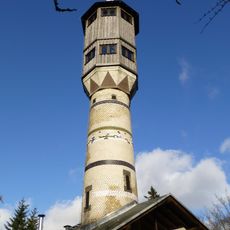
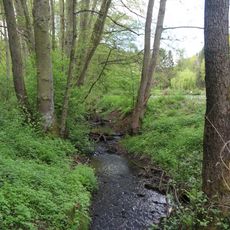
Gailscher Park is a 2.8-hectare landscape park in Rodheim, laid out from 1880 to 1900 for the Gail tobacco and ceramics family of Gießen. Its open and closed spaces, groups of trees, sculptures, watercourses and pond follow English garden models; the paths and sightlines were reworked in the 1890s by Frankfurt garden director Andreas Weber. Around the pond stand the 1880 Swiss House by Hugo von Ritgen, a clock tower of 1896, a bee house, the mosaic-faced pond house and Marianne's playhouse of 1910.
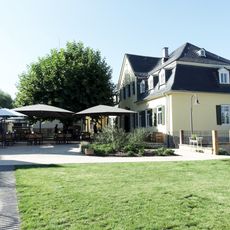
Georg Philipp Gail, a Gießen tobacco manufacturer, bought a 4,700 m² plot here in 1839 as a private garden; a branch of his tobacco factory followed in 1857. In 1880 his son Georg Karl Gail had the Schweizerhaus built by architect Hugo von Ritgen as a wedding gift for his second wife Marie. Wilhelm Gail enlarged the grounds into an English landscape garden in the 1890s under Frankfurt garden director Andreas Weber, and the villa was begun in 1896 and ready in 1897. Park and villa have been a protected ensemble since 1999.
The park's name comes from the Gail family of tobacco and ceramics manufacturers from Gießen. The clock turret on the small rise is roofed with beaver-tail tiles in Gail glazed clinker, a coloured glaze fired in a ring kiln that the firm patented in 1902. Two museums now occupy the buildings: one in the clock tower on the firm's history, one in the ice house on cold storage before refrigerators.
The grounds are open to visitors, usually through guided tours organized by an association. It is helpful to check ahead for current opening times and visiting options.
The Swiss House was built in 1880 as a wedding gift from Georg Karl Gail to his second wife Marie de Wedig; Hugo von Ritgen designed it. Its veranda is covered in dense pierced carving. The clock turret on the small rise dates from 1896 and is roofed with beaver-tail tiles in Gail glaze clinker, a coloured glaze the Gail firm patented in 1902. The claim that the turret was shown at the Paris World Exposition of 1900 is a village legend.
The community of curious travelers
AroundUs brings together thousands of curated places, local tips, and hidden gems, enriched daily by 94,350 contributors worldwide.