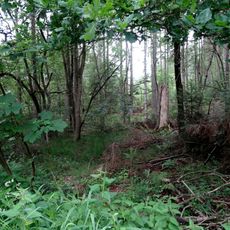
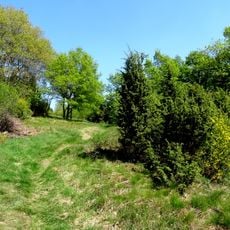
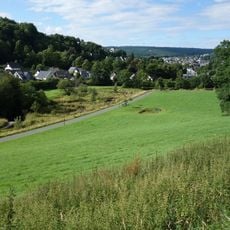
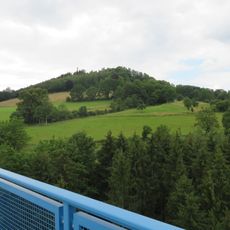
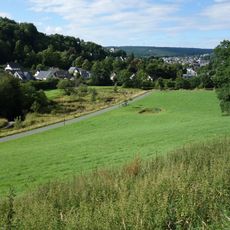
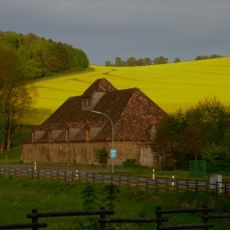
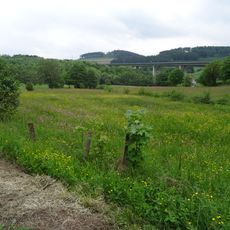
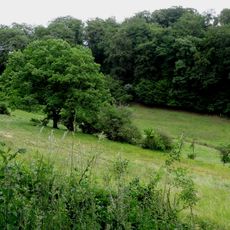
Hünenburg, Medieval fortress ruins in Meschede, Germany
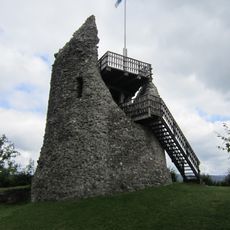
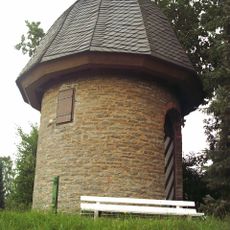
Hünenburg is a hillfort rampart site on a mountain spur north of the Ruhr east of Meschede's centre. Two concentric ramparts and ditches survive: the outer enclosure covers 2.8 hectares, the inner 0.8 hectares, measuring about 120 m north-south and 65 m west-east. The fort had five gates, a cistern and a tower; building remains inside the core wall come from a later phase.
Hünenburg dates from between the 9th and 10th centuries, with small finds dated to the 9th century; it is not mentioned in Meschede's charters. The Antiquities Commission for Westphalia carried out several excavations there between 1909 and 1914. Building remains on the inner side of the core wall come from a later construction phase, indicating a permanently occupied castle of a nobleman rather than a mere refuge; it may have been the ancestral seat of the family later called the Counts of Werl.
The name Hünenburg is not recorded in Meschede's medieval charters, so it is a later popular label rather than a documented name. The former outer bailey (Vorburg) now holds a barbecue area used by visitors, while the ramparts themselves are opened up by a circular walking trail.
The site is open and accessible for casual walking, with a marked trail that circles both earth ramparts. Visitors should wear sturdy shoes since the ground is uneven and can become slippery after rain.
The site had five gates, not five gate towers; the excavations by the Altertumskommission für Westfalen between 1909 and 1914 also found a cistern and a tower. Building remains on the inner side of the core wall point to a later construction phase, showing the castle was permanently occupied by a noble rather than used only as a refuge.
The community of curious travelers
AroundUs brings together thousands of curated places, local tips, and hidden gems, enriched daily by 93,456 contributors worldwide.