Glaubenskirche, Protestant church in Tempelhof, Germany
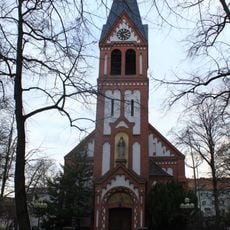
Glaubenskirche is a three-nave hall church built in 1914–1915 to designs by Ferdinand Köhler and Paul Kranz, in Reformarchitektur style with plain rendered walls and no historicist ornament. Its 50-metre transverse-rectangular tower, with an open porch of Kirchheim shell limestone, stands on Friedrich-Franz-Straße. Inside, a barrel-vaulted coffered concrete ceiling rests on fluted columns, and narrow side aisles carry galleries.
Tempelhof became an independent parish in 1892, and plans for a second church beside the old village church emerged from 1894. The foundation stone was laid on 29 March 1914; the consecration followed on 29 August 1915, after the First World War had begun. The copper roof was seized in 1918 as a metal donation for war equipment and replaced with tiles.
The name Glaubenskirche was a compromise: the parish council had favoured Siegeskirche or Kreuzritterkirche, but a neutral name was chosen. Inside, the pulpit carved by the wood sculptor Kähler shows a relief of the Knights Templar in Tempelhof, flanked by the dates 1247 (first mention of the village) and 1540 (introduction of the Reformation).
The church stands at Friedrich-Franz-Straße in Tempelhof, its 50-metre tower set back behind a U-shaped forecourt shared with three parsonages and the parish hall. The entrance hall occupies the tower's ground floor, reached through an open porch of Kirchheim shell limestone. The site is a listed ensemble, so the forecourt is best viewed from the street side.
The altar painting is by Professor Ernst Christian Pfannschmidt and depicts the Centurion of Capernaum, an unusual choice for religious artwork. This subject links military and spiritual themes in an original way.
The community of curious travelers
AroundUs brings together thousands of curated places, local tips, and hidden gems, enriched daily by 93,849 contributors worldwide.