Schloss Gusow, Gothic Revival château in Gusow-Platkow, Germany
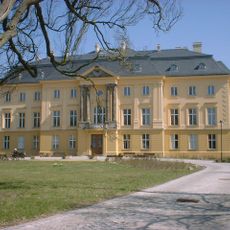
Schloss Gusow is a two-storey, three-winged manor house in Gusow-Platkow, rebuilt in 1870–1873 in English Gothic Revival style to plans by Wriezen master builder Ferdinand Neubart, inspired by Karl Friedrich Schinkel, with Tudor details and richly ornamented chimney heads. Corner towers with conical roofs flank the wings, and gables highlight the risaltes. It is privately owned and cannot be entered.
Gusow was first documented in 1353 as a secondary estate of the von Barfus family. In 1649 Field Marshal Georg von Derfflinger acquired the manor; his son Friedrich inherited it in 1695. General Heinrich Karl von der Marwitz bought it in 1724, and from 1750 Otto Friedrich Christoph von Podewils expanded the house into a three-wing complex. The Schönburg family held it from 1804 until 1945, and the house was rebuilt in Gothic Revival style in 1870–1873 to plans by Ferdinand Neubart.
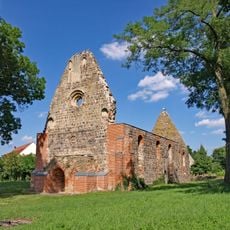
The name Gusow goes back to the von Barfus family, who held the estate as a fief from 1353. From 1804 the house of Schönburg used the castle not as a residence but as a hunting and summer seat, and Prussian kings came here as hunting guests. The park holds neo-Gothic ruins laid out in 1781 by Friedrich Heinrich von Podewils.
The castle is privately owned and cannot be entered; visitors can only view it from the outside, along with its park, which has been neglected since the 2020s. It stands on rising ground at the edge of the Oderbruch, in the municipality of Gusow-Platkow.
The castle is privately owned and cannot be entered; its grounds have looked neglected since the 2020s. Theodor Fontane devoted a section of his Wanderungen durch die Mark Brandenburg to Gusow. Two recumbent stags by Christian Daniel Rauch, cast in 1843/44, once flanked the approach to the cour d'honneur.
The community of curious travelers
AroundUs brings together thousands of curated places, local tips, and hidden gems, enriched daily by 94,356 contributors worldwide.