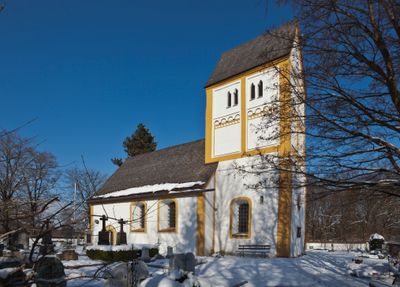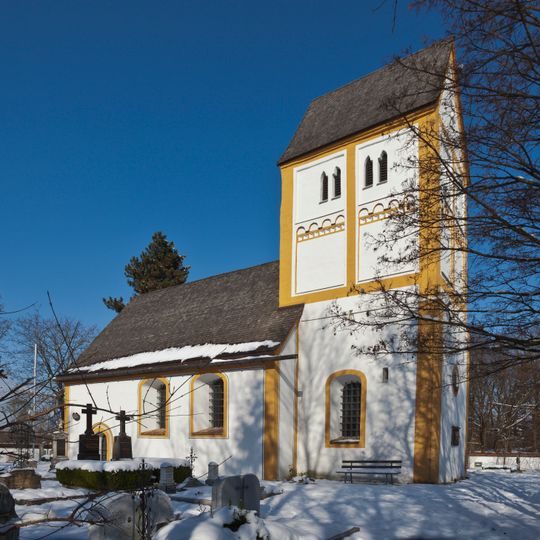
Holy Cross Church, Catholic church in Milbertshofen-Am Hart, Munich, Germany.
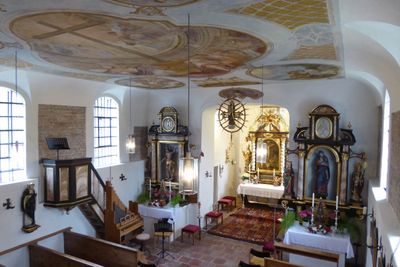
Holy Cross Church is a late Romanesque choir tower church in Fröttmaning, Munich, built mainly in the early 13th century. Its exterior has white plaster with yellow vertical and horizontal bands, a steep gray shingled roof, and rows of small blind arches; the choir tower rises 18 meters. Inside, the flat ceiling carries faded frescoes painted around 1740 by pupils of the Asam brothers, and the walls are white.
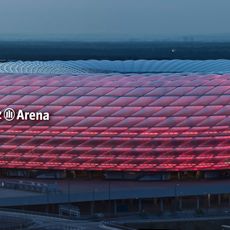
A wooden church was donated to the Freising bishopric by the noble Situli in 815, the oldest document in the Bavarian State Archive. The present late Romanesque building with thick walls dates mostly from the early 13th century. In the 1930s it became a filial church of St. Albert; later citizen protests led by Ludwig Maile saved it from demolition, shifting the Munich-Nord motorway junction and, in the 2000s, the Allianz Arena rescue road.
The church keeps its medieval dedication to the Holy Cross, and the ceiling fresco painted by pupils of the Asam brothers around 1740 shows the veneration of the cross that Emperor Heraclius brought back from Jerusalem in 629. Since 1930 it has been a branch church of St. Albert in Freimann.
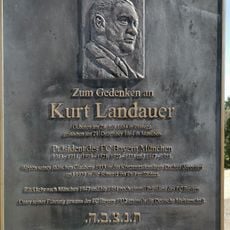
The church stands at Kurt-Landauer-Weg 8, east of the A9 and just south of the Munich North motorway junction, north of the Fröttmaning hill. It is a branch church of St. Albert in Freimann, so the interior is not always open; check locally before travelling. The site is reached on foot from the surrounding paths.
About 150 metres south of the church, Timm Ulrichs's 2006 artwork "Versunkenes Dorf" sinks a full-size, inaccessible concrete replica of the Romanesque building into the grassy Fröttmaning hill, leaving only part of the tower and nave visible. The title quotes an 1813 poem by Friedrich Rückert.
The community of curious travelers
AroundUs brings together thousands of curated places, local tips, and hidden gems, enriched daily by 92,887 contributors worldwide.