Heidenwall, Medieval archaeological site in Hamburg-Altstadt, Germany
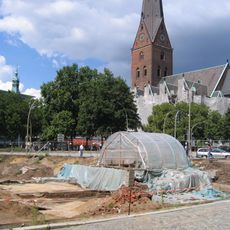
The Heidenwall extends for 300 meters from an Elbe tributary to the Alster river and shows remnants of medieval defensive structures and ditches. The construction consists of stone foundations and earthen walls that shape the landscape today.
Built in the 11th century as Hamburg's first defensive system, this site protected early settlements around Hammaburg from attacks by Slavic forces. The structures reveal how the emerging city secured its boundaries against external threats.
The archaeological remains mark the historical parish boundary between St. Peter and St. James churches, showing how medieval Hamburg was divided by religious communities. This spatial division shaped where residents belonged and how they organized their daily lives.
Sections of the wall and ditch were discovered in 1938 during construction work at Speersort, providing researchers with valuable information about medieval fortifications. Parts of these remains are visible in the landscape today and can be observed while walking through the old town.
A circular stone foundation discovered in 1962 near St. Peter's Church represents Hamburg's oldest city gate and was the point where an ancient road crossed through. This small structure shows how important this location was as a passage and control point for early trade.
The community of curious travelers
AroundUs brings together thousands of curated places, local tips, and hidden gems, enriched daily by 60,000 contributors worldwide.