Grätzelhaus, Heritage building in Göttingen, Germany.
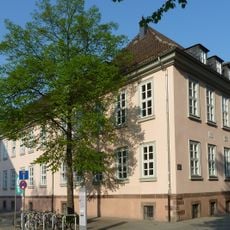
The Grätzelhaus is a three-storey Baroque townhouse at Goethe-Allee 8, built 1739–1741 for the textile entrepreneur Johann Heinrich Grätzel. Its sixteen-axis plastered timber-frame facade faces the street, while the eastern narrow side borders the Leine Canal. A shallow central riser with a gable carries statues of Pallas Athena and Hermes, and the sandstone portal is framed by two pairs of columns.
Johann Heinrich Grätzel, a Dresden-born cloth manufacturer who settled in Göttingen in 1711, built the house between 1739 and 1741; a building ordinance of 13 December 1735 and tax exemptions promoted new housing for the university. The family owned it until 1891, when it was sold to a piano manufacturer; the Hotel National with its Café National followed, and cafés and restaurants have occupied the ground floor since.
The name recalls Johann Heinrich Grätzel, the Dresden-born cloth manufacturer who built the house and became the largest industrial employer in Göttingen and southern Hanover. Since 1891, when the Grätzel family sold it, the ground floor has housed cafés and restaurants, continuing as a meeting place on Goethe-Allee.
The building sits in a residential neighborhood of Göttingen and is easily accessible on foot with a map or navigation app. The location works well as a stop during a walk through the older parts of the city.
In the garden behind the house, which no longer survives, Grätzel placed twelve statues of boys representing the six senses and the six liberal arts. Inside, the heavy wooden staircase and the classicist picture wallpapers of the former festival hall, printed in 1830 by the Parisian firm Dufour & Leroy, were still noted in the 1949 Dehio handbook; since a 1964 conversion these interiors are held by the Städtisches Museum.
The community of curious travelers
AroundUs brings together thousands of curated places, local tips, and hidden gems, enriched daily by 93,151 contributors worldwide.