Grüner Mühle, Watermill at Marburg, Germany
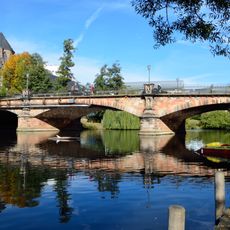
Grüner Mühle is a former oil and paper mill on the Lahn below the Weidenhäuser Brücke, at the edge of Marburg's Südviertel. Its undershot mill wheel survives but no longer turns; one building now holds a restaurant and several apartments. The 73 m Grüner Wehr beside it dams the water and feeds the mill canal running south parallel to the river.
The mill was first documented in 1248. In 1320 Bishop Ludwig of Münster renounced his claim, and Landgrave Otto I gave it to the Teutonic Order, which traded it back to the landgrave in 1496. A new oil mill was built in 1456 and a paper mill added in 1570; from 1583 or 1584 a waterworks pumped Lahn water up to a cistern at the Landgrafenschloss.
The name Grüner Mühle ties the mill to the street "Am Grün" and the Grüner Tor at the southern end of Marburg's old water front, where small houses stand directly on the Lahn bank. The site lies at the weir below the Weidenhäuser Brücke, and the mill canal branching off here was called "Kupfer-Mühl-Wasser" in 1722.
The site sits along the river and is accessible on foot from the town center, though parking nearby is limited. Visitors should note that paths around the building are sometimes uneven and sturdy footwear is advisable.
The 73-metre Grüner Wehr below the mill is a slanted block-stone weir whose origins the monument council dates to the Renaissance, around 1553. It stands on gravel over wooden piles and still backs up the mill canal once called the "Kupfer-Mühl-Wasser". Plans to add a fish ladder and modernise it for leisure use have been contested because of tree felling along the Trojedamm.
The community of curious travelers
AroundUs brings together thousands of curated places, local tips, and hidden gems, enriched daily by 92,886 contributors worldwide.