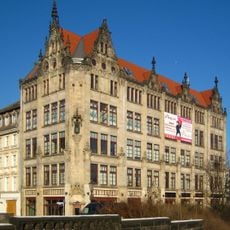
Grünstraßenbrücke, Stone bridge in Mitte, Germany.
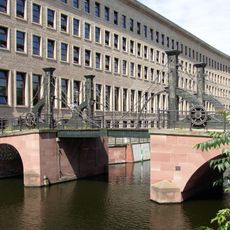
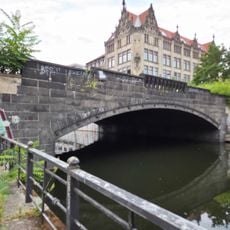
The Grünstraßenbrücke is a stone bridge in Mitte that spans a waterway in central Berlin. It is roughly 40 meters long and nearly 18 meters wide, connecting different areas of the district with its solid construction.
A wooden bridge with flaps for ship passages stood here in the old Kölln town centre before the stone Grünstraßenbrücke was built from 1903 to 1905. The Berlin magistrate ordered the rebuild after the neighbouring Roßstraßenbrücke and Gertraudenbrücke had been replaced in stone; Richard Wolffenstein designed the vaulted structure and Ernst Westphal the reliefs. German Wehrmacht specialists blew it up in early 1945, and the East Berlin administration repaired it in 1951.
The bridge takes its name from Grünstraße, which in turn refers to the green of the marshy Spree island. Sculptor Ernst Westphal carved reliefs on both sides showing everyday scenes: a group of four people pulling someone from the water, and washerwomen at the river exchanging news. The washerwomen may allude to Wilhelm Spindler's nearby laundry and dye works in the Spindlershof.
The bridge is closed to through motor traffic, so it is a calm crossing for pedestrians and cyclists. A narrow staircase on the east side leads down to the riverside path. Four street lamps shaped like historic gas lanterns stand along the walkway.
The 19 m figure refers to the bridge's width, not a span: the sandstone-faced structure was built with 4 m wide sidewalks on each side. Its large visible surfaces are clad in Muschelkalk limestone, and a bear coat of arms faces the Spree at each side of the bridge crown.
The community of curious travelers
AroundUs brings together thousands of curated places, local tips, and hidden gems, enriched daily by 93,910 contributors worldwide.