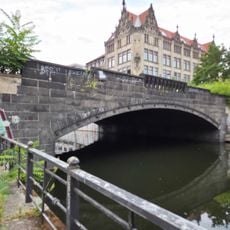
Jungfern Bridge, Footbridge in Berlin-Mitte, Germany.
The Jungfern Bridge is an iron footbridge spanning about 28 meters across the Kupfergraben and connecting Friedrichsgracht to Oberwasserstraße. Its three-span structure rests on two piers set in the water, allowing the longest section to stretch across the central channel.
A wooden drawbridge was built here in 1688, probably by Martin Grünberg, first called Spreegassenbrücke; the name Jungfernbrücke is recorded from 1690. In 1798 Friedrich Becherer replaced it with a wood-and-iron structure whose middle section could still be raised by chains and wheels. Renovations in 1937–39 lengthened the piers by three metres, disabled the lifting gear and replaced the ramps with stairs, making it pedestrian-only.
The name's origin is uncertain; legends tell of a men-only river bath where maidens waited, a wedding custom testing the bride by creaking planks, and Huguenot sisters nearby who sewed fine linen and spread Berlin's gossip, earning the nickname Klatschbrücke (Gossip Bridge). The bridge appears on a 1985 GDR special stamp series.
Since the 1937–1939 works replaced the approach ramps with stairs, the bridge is open to pedestrians only. It links Friedrichsgracht with Oberwasserstraße across the Spreekanal in Berlin-Mitte. The deck is a wooden plank surface on steel beams, with red Miltenberg sandstone vaults added in the 1998/1999 restoration.
The lifting mechanism was decommissioned between 1937 and 1939, when the riverbed was deepened and the piers were lengthened by three metres; the hinged side sections were replaced by a continuous deck of steel beams with wooden planks. The bridge was also depicted on a 1985 special stamp series issued by the GDR postal service.
The community of curious travelers
AroundUs brings together thousands of curated places, local tips, and hidden gems, enriched daily by 92,942 contributors worldwide.