Former Reichsbank building, Government building in Mitte, Germany.
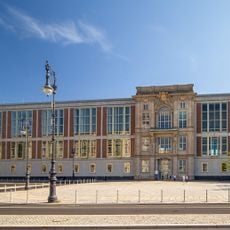
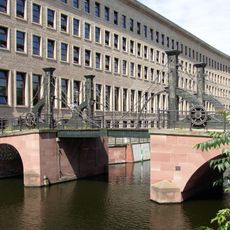
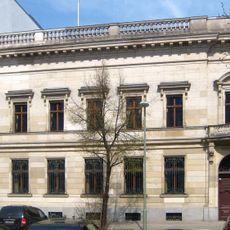
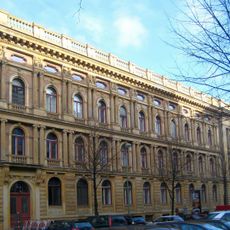
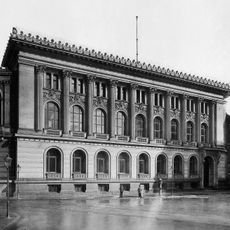
The Haus am Werderschen Markt is a stone-faced building on Werderscher Markt, built 1934–1940 over a reinforced concrete core to Heinrich Wolff's design. Its long facade of light grey-beige stone blocks rises several storeys above a solid base, divided by broad vertical piers into a grid of tall narrow windows; the ground floor has square openings and larger rectangular windows between thicker pillars, and a stepped stone platform runs along the base. The flat roofline is unadorned.
The building was constructed in the 1930s according to designs by Heinrich Wolff and served until 1945 as the seat of the German central bank. After World War II it was repurposed and later fulfilled other state functions.
Among party members the building was known as the "Große Haus", the political power centre of the GDR between 1959 and 1990. The former cash halls of the Reichsbank were converted into festival and congress rooms, with cash hall 3 becoming the plenary hall of the SED Central Committee. On the walkable roof terrace a relief of a Berlin bear wearing a mural crown survives, its banner reading "HEINRICH WOLFF BAUTE DIESES HAUS IN DEN JAHREN 1935-1939".
The building sits at Werderscher Markt in Mitte and is used today as an administrative facility with limited visitor access. Prior arrangement or special purpose is usually needed to view the interior.
On the walkable roof terrace, a large square relief shows Berlin's heraldic bear wearing a mural crown on a suggested green island; its banner reads "HEINRICH WOLFF BAUTE DIESES HAUS IN DEN JAHREN 1935-1939". Inside, a working paternoster lift still runs, a rare survival in a German ministry.
The community of curious travelers
AroundUs brings together thousands of curated places, local tips, and hidden gems, enriched daily by 93,029 contributors worldwide.