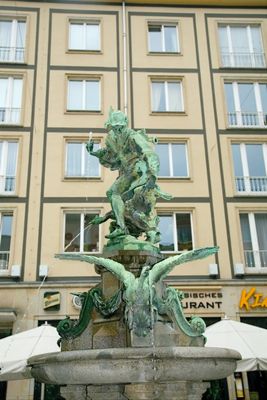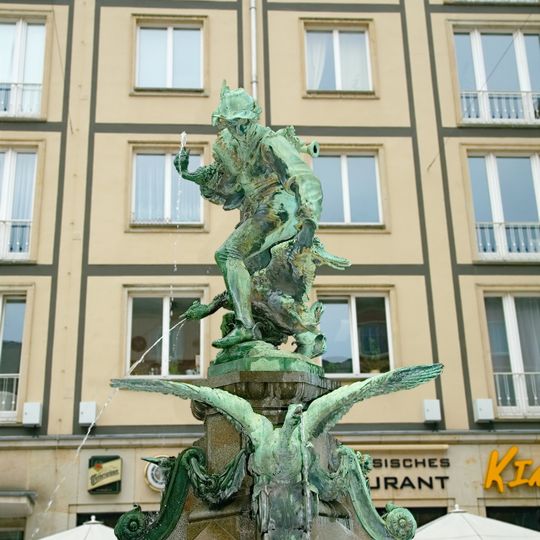
Gänsediebbrunnen, Bronze fountain in Dresden, Germany.
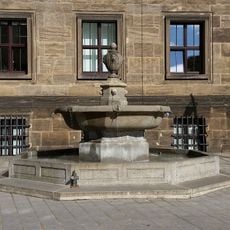
Gänsediebbrunnen is a fountain in Weiße Gasse in Dresden's Innere Altstadt, consisting of a bronze figure on a stone pedestal within a water basin. The bronze, cast in 1878 by Robert Diez, shows a young man stealing two geese. The basin parts are made of Lusatian granite, designed by architects Paul Weidner and Giese, and cast by C. Albert Bierling.
The bronze figure was made by Robert Diez in 1878; the fountain was inaugurated on 20 April 1880, Diez's 36th birthday, on Ferdinandplatz, funded by the Güntzstiftung. It survived the February 1945 air raids largely intact, was dismantled in 1949 and stored in a Rathaus courtyard, and was re-erected in 1961 in the Weiße Gasse, without its ornamental grille.
The fountain depicts Thomas Platter (1499–1582), later a printer and rector of the Latin school in Basel, stealing two geese. In 1512, while a wandering scholar, he visited Dresden's Kreuzschule and stole the geese for a farewell meal with the schoolmaster. The bronze figure was made by Robert Diez in 1878.
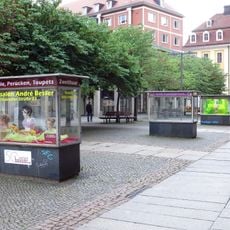
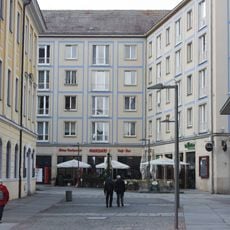
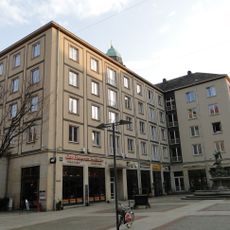
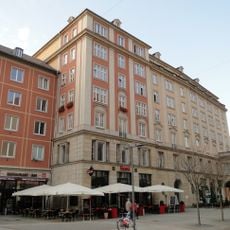
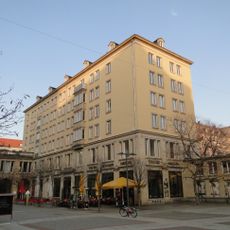
The fountain stands in the Weiße Gasse in Dresden's Innere Altstadt, a pedestrian lane in the quarter north of the Altmarkt. The basin is fed by four columns carrying a collecting bowl, so the bronze thief and the two geese on the base are best seen by walking around the basin. The ornate grille that once surrounded it was not reinstalled in 1961.
The bronze was cast by the Dresden foundry C. Albert Bierling; the granite parts in Lusatian granite were designed with the architects Paul Weidner and Giese. The sculpture won the Great Gold Medal at the 1879 International Art Exhibition in Munich. A copy stands in Pößneck, Diez's hometown, and the trial cast of the figure is in Augustusburg in the Erzgebirge.
The community of curious travelers
AroundUs brings together thousands of curated places, local tips, and hidden gems, enriched daily by 92,893 contributors worldwide.