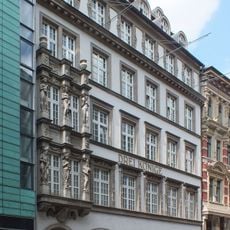
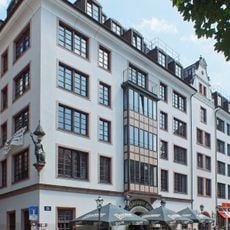
Stadthaus, Cultural heritage monument in Leipzig, Germany.
The Stadthaus is a seven-storey municipal building on an irregular five-sided plan, built 1908–1912 by city architect Hugo Licht next to his Neues Rathaus. Its brick masonry is faced with Muschelkalk stone, and a two-storey bridge over Lotterstraße links it to the town hall. It occupies Burgplatz 1, Martin-Luther-Ring 8–8a and Markgrafenstraße 3, and was badly damaged by bombs on 16–17 April 1945.
Construction started in 1908 and finished in 1912 during a period of rapid urban modernization in Leipzig. The building emerged during a time when the city was investing heavily in new public structures to support its growth.
The Stadthaus houses Leipzig's registry office, and its large and small wedding halls have been used for marriages since 1911. Both wood-panelled ceremony rooms are artistically decorated, and the corridor in front holds a wall fountain of polished Jurassic marble with decorated tile cladding. The halls have their own ceremonial entrance from the Martin-Luther-Ring.
The building sits centrally in Leipzig and is easily accessible on foot with clear visibility from the street. Interior access may vary depending on current use and opening times, so checking ahead is recommended.
The two-storey bridge over Lotterstraße linking the Stadthaus to the Neues Rathaus is popularly called the "Beamtenlaufbahn" — a pun on the civil servant's career path and a running track. The Stadthaus was badly damaged by bombs on 16–17 April 1945, and the neighbouring Berger & Voigt building at the northwest corner was destroyed outright; the eleven-storey Trias office block was completed there in June 2014.
The community of curious travelers
AroundUs brings together thousands of curated places, local tips, and hidden gems, enriched daily by 93,052 contributors worldwide.