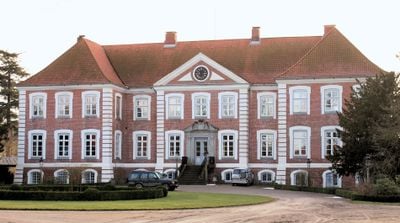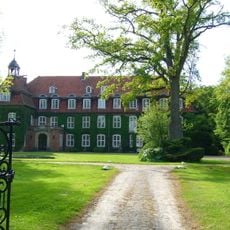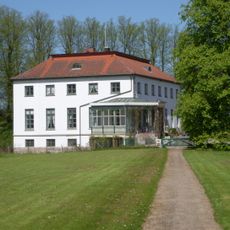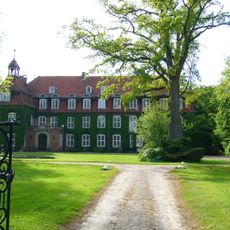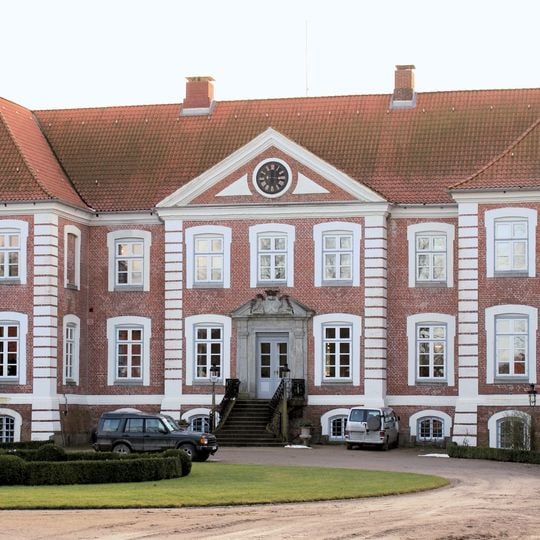
Gut Güldenstein, Baroque manor house in Harmsdorf, Germany.
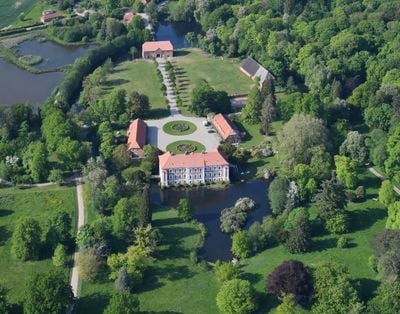
Gut Güldenstein is an eleven-bay brick manor house with two full storeys and a basement, built in 1726–1728 to plans by Rudolph Matthias Dallin. It stands at the end of an oval courtyard island, half in the water, with two shallow one-window-deep wings framing the court side. A triangular pediment marks the central bay, and the sandstone portal carries the double coat of arms of the Thienen and Brockdorff families.
A medieval water castle once stood on this site until 1726, when it was replaced by the current Baroque structure designed by architect Rudolph Matthias Dallin. This transformation marked the shift from medieval fortifications to the refined residential style of the 18th century.
The sandstone portal bears the double coat of arms of the Thienen and Brockdorff families, linking the builder Heinrich von Thienen to his wife's lineage. The estate remains in the hands of the ducal House of Oldenburg, which acquired it in 1839, and annual equestrian tournaments are still held on the grounds.
The manor house is inhabited and not open to the public; it can only be viewed from outside, from the public paths. The gatehouse of 1743, restored in 2008–2009, and the two single-storey buildings flanking the courtyard, the Kavaliershäuser and the Marstall, stand along the north–south axis of the estate.
The sandstone portal carries the double coat of arms of the Thienen and Brockdorff families, a detail easily missed from the public path. Heinrich von Thienen commissioned the house in 1726 from Eutin court architect Rudolph Matthias Dallin, and it was finished in 1728.
The community of curious travelers
AroundUs brings together thousands of curated places, local tips, and hidden gems, enriched daily by 92,722 contributors worldwide.