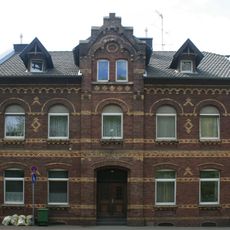
Gut Weyern, Heritage monument in Düren, Germany.
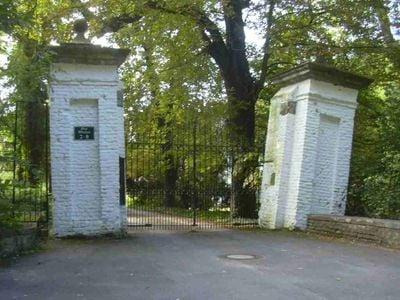
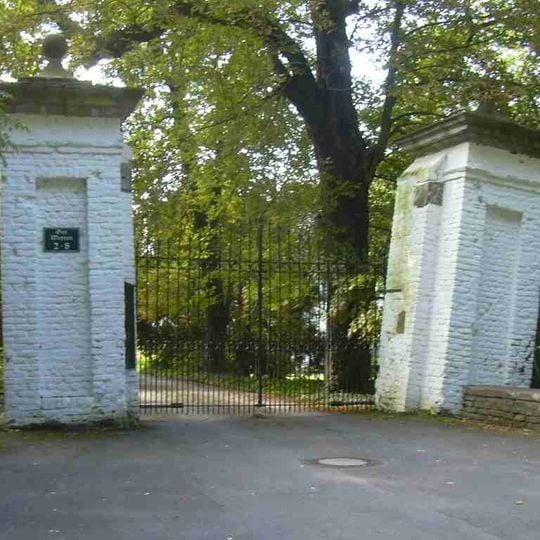
Gut Weyern is a manor house with farm buildings at the edge of the Burgauer Forest near Düren. The two-story, five-bay brick house with stone window surrounds dates from the early 18th century and has a gabled roof. The estate is partly surrounded by a moat, and a baroque stone archway stands on an artificial peninsula in the Hausweiher pond. Two slanted brick pillars flank the entrance drive.
The estate, formerly called Grevenweyer, belonged to the Counts of Jülich before 1336 and later to the Dukes of Jülich-Berg until the French takeover. On 13 July 1804 it was sold by the French state for 17,200 francs to Ferdinand Joseph Effertz, who three days later declared he had bought it for the Düren businessman Johann Paul Schenkel. The city of Düren acquired the property from the Prym heirs on 28 June 1940 for 328,000 Reichsmark, including 330 Morgen of land.
The name Grevenweyer, used before 1336, combines "Greven" (counts) with "Weyer" (pond), referring to the fishponds fed by a Rur pond and a nearby spring. In 1756 the estate bred pike, carp, tench, perch, crucian carp, eels and whitefish. The two brick pillars at the drive, leaning outward, date from the 18th century.
Gut Weyern lies in the Dürener Stadtwald (Burgauer Wald) at the edge of Düren, opposite the Berufsförderungswerk Düren. The entrance is marked by two outward-leaning brick pillars from the 18th century, now painted white, one bearing a plaque reading "Städt. Weyern 2-5". Part of the estate is enclosed by a moat, so the grounds are best viewed from the surrounding forest paths.
Beside the estate entrance sits a grass-covered mound containing rubble from Düren's destruction during the air raid of November 16, 1944. This unassuming rise serves as a quiet reminder of the devastation that once struck the city.
The community of curious travelers
AroundUs brings together thousands of curated places, local tips, and hidden gems, enriched daily by 94,027 contributors worldwide.