Gutenberg memorial, Bronze monument in Gutenberg Square, Mainz, Germany.
The Gutenberg memorial is a classicist bronze statue on Gutenbergplatz in Mainz, cast in Paris in 1836 from models by Bertel Thorvaldsen. Gutenberg stands in a soft cap and long open coat, holding a small sprig in his right hand and a tablet inscribed "Johannes Gutenberg" against his chest with his left. The bronze has a greenish patina; the low base is largely hidden from view.
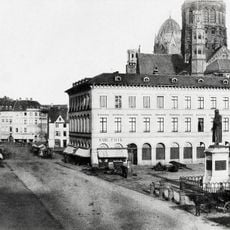
The first proposal for a Gutenberg monument came from Georg Christian Wedekind in 1792, after Jacobin Anacharsis Cloots demanded Gutenberg's remains be moved to the Paris Panthéon. Napoleon's administration planned the square from 1804, but the statue was only cast in Paris in 1836 in Charles Crozatier's workshop. It was unveiled on Gutenbergplatz during the Gutenberg festival of 14–16 August 1837, at a total cost of 18,621 guilders.
The square where the statue stands was laid out under Napoleon as the Place Guttemberg, part of a ceremonial street, and a monument was planned there from the start. The 1837 unveiling took place during a Gutenberg festival held from 14 to 16 August. The base reliefs show Gutenberg with a boy in the printing workshop and with a man in the typesetting workshop.
The memorial sits on an open square in central Mainz and is easy to reach on foot. The statue is clearly visible from outside, and the square itself has room to walk around and view it from different angles.
In May 2008 the bronze was taken to a metal-restoration workshop in Regensburg because of cracks and corrosion, even in its stabilizing core. During the 2009 carnival a papier-mâché Gutenberg figure was hoisted onto the empty base, and that December an Advent wreath was placed there to deter climbers. The statue returned on 4 February 2010.
The community of curious travelers
AroundUs brings together thousands of curated places, local tips, and hidden gems, enriched daily by 92,831 contributors worldwide.