Haus in der Sonne, Timber-framed cultural heritage monument in Radebeul, Germany.
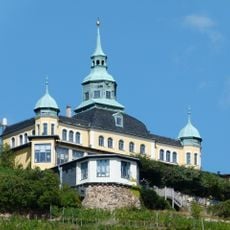
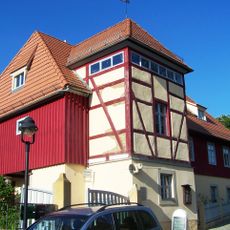
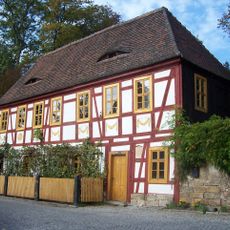
Haus in der Sonne is a timber-framed house in Radebeul, a town just west of Dresden, where exposed wooden beams divide the facade into a grid of lighter infill panels. The building is listed as a cultural heritage monument, recognizing its structural integrity and its place within the local built landscape.
Georg Christian Städter, a Saxon electoral mint official, had the baroque winegrower's house built in 1770 on the Kröber vineyard by master mason Heerklotz of Hoflößnitz and master carpenter Gottschalk of Königstein. From 1790 the buildings were repeatedly extended; in the early 19th century the merchant Friedrich Zembsch owned the estate and called it Friedrichsburg. After the phylloxera disaster of the mid-1880s it was divided into five flats around 1900, and in 1917 the architect Martin Hammitzsch acquired it.
The name Haus in der Sonne was given by architect Martin Hammitzsch around 1920/1921, referring to the house's exposed position facing south. Reliefs set into the facade show agricultural motifs and two putti weighing the house against a money purse. Above the north entrance reads the Latin motto non mihi sed posteris, "not for me, but for posterity".
The building is best seen from the outside during daylight, when the wooden beams and infill panels are clearly visible. Walking through the surrounding streets gives a broader sense of how this house fits into the older fabric of Radebeul.
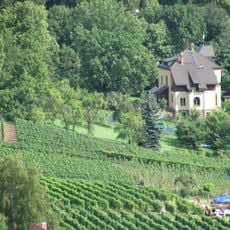
The name of the house translates as House in the Sun, pointing to its sunny hillside position that receives light for most of the day. This type of south-facing slope was traditionally used for growing grapes in Radebeul, which explains why the house stands where it does.
The community of curious travelers
AroundUs brings together thousands of curated places, local tips, and hidden gems, enriched daily by 94,307 contributors worldwide.