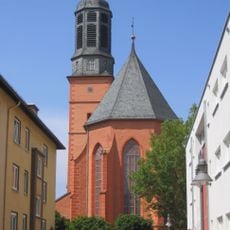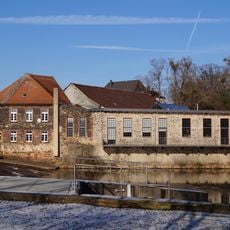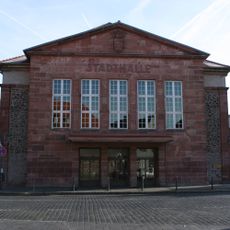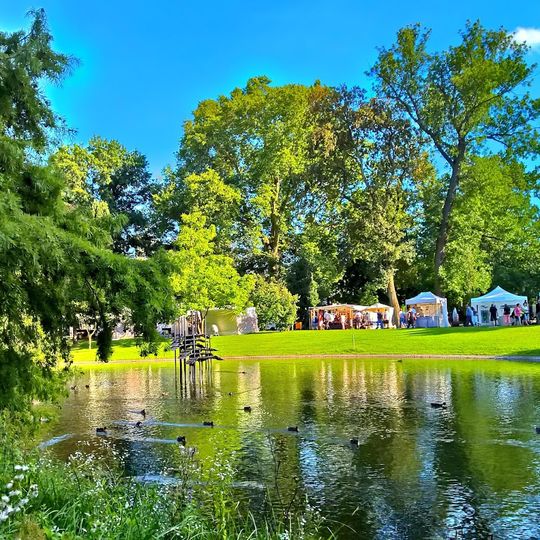
Schlossgarten Hanau, Heritage park in central Hanau, Germany.
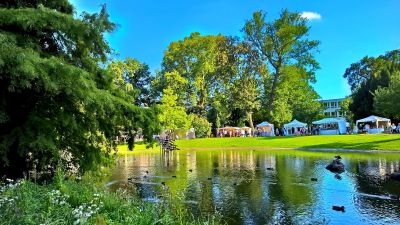
The Schlossgarten Hanau is an inner-city park created between 1760 and 1764 as the garden of the Hanau city palace. It surrounds the site of the medieval castle, demolished in 1829, and was redesigned from 1824 by Wilhelm Hentze and Louis Meinicke with a pond, a snail mound and an arm of the Kinzig. Old trees include a pyramidal oak and a dawn redwood.
A landgravine founded the garden in 1766, creating one of the first English landscape gardens on mainland Europe. The design established new standards for how parks were understood and created at that time.
The garden reflects an English landscape design style from the 1700s that shaped how parks were built across Europe. Walking through today, you can see how this approach to garden design has influenced the open spaces around you.
The park is open daily and free to enter. The Kinzig arm flows through the grounds; its outflow runs in pipes under the Heinrich-Fischer-Bad in the northwest. A bridge railing at Heinrich-Bott-Straße/Eugen-Kaiser-Straße marks where the former castle moat met the town fortification ditch.
Among the park's old trees are several designated natural monuments, including a pyramidal oak, an ash, a swamp cypress, a dawn redwood and an Austrian black pine. The bronze sculpture "Die sechs Schwäne und ihre Schwester" by Albrecht Glenz was placed by the central pond in 2014.
The community of curious travelers
AroundUs brings together thousands of curated places, local tips, and hidden gems, enriched daily by 93,712 contributors worldwide.