Herrenmühle, Historic watermill in Hanau, Germany.
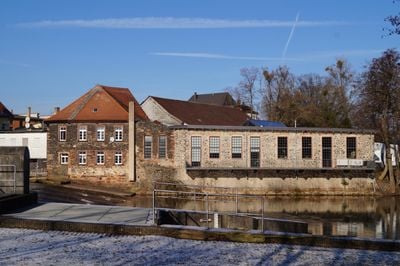
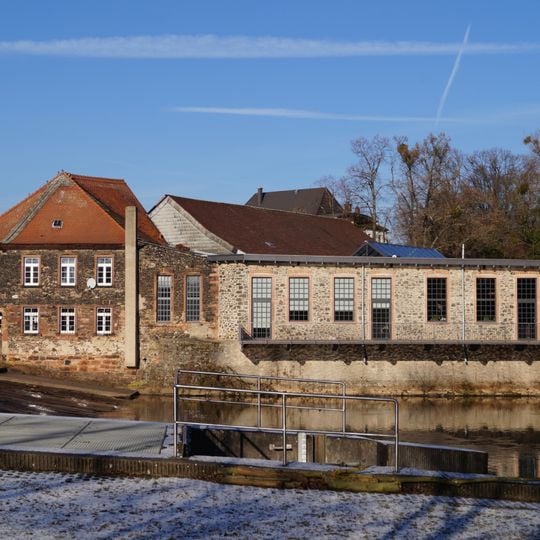
The Herrenmühle is a former watermill complex on a Kinzig bend east of Hanau's old town, cut by the Mühlengraben and fronted by the Nordstraße. The surviving buildings include a red-tiled, gable-ended block of stone and brick with two rows of three white-framed windows, a long stone building with tall gridded windows above a foundation wall at the water's edge, and a square stone chimney between them. A weir, a 16th/17th-century bridge and the mill basin remain.
First documented in 1402, the mill replaced an earlier castle mill under the counts of Hanau. It operated with multiple grinding mechanisms as a major grain processing center for the region.
The name refers to its connection to the rulers of Hanau, reflecting its importance as a facility they controlled. The Renaissance structures visible today show how central this mill was to local craft and commerce.
The complex lies on the Nordstraße side of the Kinzig peninsula east of Hanau's old town and castle, where the Mühlengraben cuts across the bend. The weir sits just below the point where the millrace leaves the Kinzig, and the 16th/17th-century bridge crosses the channel. The preserved structures — weir, bridge, mill basin, remains of the buildings from around 1730 and the turbine house — are viewed from outside; the site is a protected Kulturdenkmal and part of the Route der Industriekultur Rhein-Main.
The mill was adapted into a power station in later years, with turbines replacing five original mill wheels in 1874 for electricity generation. This innovative use of water power showed how the site adapted to new technologies and remained productive until 1942.
The community of curious travelers
AroundUs brings together thousands of curated places, local tips, and hidden gems, enriched daily by 93,340 contributors worldwide.