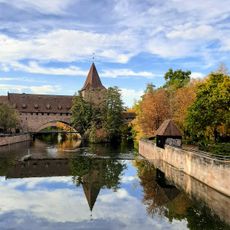
Hallerwiese, Public park in Nuremberg, Germany.
Hallerwiese is a 1.7-hectare park in Nuremberg's St. Johannis district, lying outside the old town between the Hallertorbrücke and the Großweidenmühlsteg on the right bank of the Pegnitz. It consists of large open lawns, rows of old linden trees and the bronze Schnepperschützen-Brunnen in the middle; a combined foot and cycle path runs along its southern edge by the river.
In May 1434 the city council bought the meadow by the Pegnitz from Margareta Heyden, née Haller, for 561 pounds and opened it to all inhabitants for pleasure. This makes it Nuremberg's oldest publicly dedicated green space. Paulus Vorchtel had rows of linden trees planted between 1449 and 1453; they were felled in 1552 during the Second Margrave War and replanted seven years later.
The Schnepperschützen-Brunnen, a bronze figure of a crossbowman in 16th-century court hunting dress, was set up in 1904 on a donation from the St. Johannis citizens' association, recalling the crossbowmen's festivals held here until 1768. The fountain still runs. The park's name comes from the patrician Haller von Hallerstein family, who sold the meadow to the city in 1434.
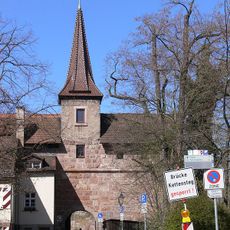
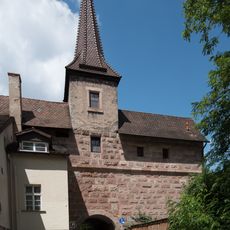
A combined foot and cycle path runs along the southern edge of the park beside the Pegnitz, forming part of the route toward Fürth. Dense trees and shrubs along the bank block the view of the river over long stretches. A footpath through the Hallertürlein, east of the meadow, leads into the Sebald old town; the Café Schnepperschütze sits at the park's eastern entrance by the Hallertorbrücke.
The park's name honours the patrician Haller von Hallerstein family, who sold the meadow to the city council in May 1434 for 561 pounds. A memorial plaque at the Hallertürlein gate records that the council then opened the ground to all inhabitants for pleasure and recreation.
The community of curious travelers
AroundUs brings together thousands of curated places, local tips, and hidden gems, enriched daily by 92,654 contributors worldwide.