Hallesche-Tor Bridge, Arch and road bridge in Kreuzberg, Berlin, Germany
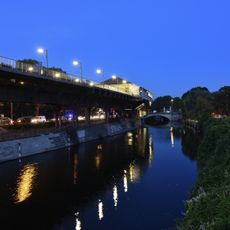
The Hallesche-Tor Bridge spans the Landwehr Canal and connects different parts of Kreuzberg with its distinctive structure from the 19th century. The construction displays four sculptural groups at its corners that represent commerce and transportation, shaping the urban character of this district.
A wooden bridge stood here from 1705, before the Hallesches Tor of Berlin's customs wall. After the ditch became the Landwehr Canal, Heinrich Strack designed a sandstone-clad brick bridge, built 1874–1876 under Emil Dietrich for about 500,000 marks and inaugurated as the Belle-Alliance-Brücke. Damaged in 1945, it was rebuilt in 1953 on Strack's plans and renamed Hallesche-Tor-Brücke in 1974.
The bridge's four allegorical marble figures, set up shortly after the 1876 inauguration, depict river shipping by Otto Geyer, fishing by Julius Moser, industry by Eduard Lürssen and fruit trade by Friedrich Reusch. A market was once held directly on the bridge, where Italian traders offered plaster figures to local residents.
The bridge accommodates both vehicle and pedestrian traffic and offers direct access to the nearby Hallesches Tor U-Bahn station. The location is well marked and becomes quite busy during peak hours.
The Fischfang sculpture by Julius Moser left the bridge when the elevated railway was built in 1904; it stood on the Melanchthonbrücke until that bridge was demolished in 1957, then moved to the Sedanufer, and returned restored to its original spot in 1989. The Fruchthandel group was destroyed in the war and the Gewerbefleiß was removed in 1945, its whereabouts unknown.
The community of curious travelers
AroundUs brings together thousands of curated places, local tips, and hidden gems, enriched daily by 92,641 contributors worldwide.