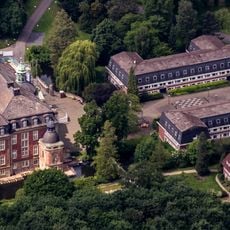
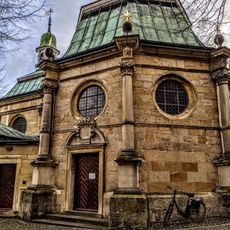
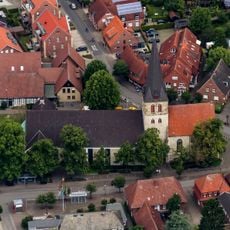
Haus Bevern, Heritage castle in Ostbevern, Germany.
Haus Bevern was a Renaissance water castle in Ostbevern, almost entirely demolished between 1827 and 1834. Only the prison tower of the outer bailey survives, now used as an archive tower and privately owned. A later half-timbered house on the site served as a forestry yard, and an information column was installed in September 2011.
Named after the von Bevern family, the moated castle is documented as the Nygenhof in 1294, as "hus tho Beveren" in 1367 and as "borch to Beveren" in 1372. It passed by inheritance to the von Vechtrup and then the von Schencking, and in 1707 to Amalia von Reede. Justice was pronounced here until 1809; the dilapidated castle was demolished between 1827 and 1834, leaving only the prison tower.
The name comes from the noble von Bevern family, ministeriales of the Bishop of Münster who served as Drosten of Ostbevern, a post they shared with the Lords of Loburg. Disputes over jurisdiction at the site are recorded between the von Schencking and von Nagel families. The parish church of St. Ambrosius is thought to trace its founding to them.
Only the prison tower, now used as an archive tower, and the later timber-framed forest farmhouse remain on the private site; the tower has been a listed monument together with the archive since 11 August 1988. An information column was installed in September 2011. The property is still owned by the von Droste zu Vischering family, so view it from the public way.
The prison tower survived the 1827–1834 demolition and has served as an archive tower since; it has been a protected monument since 11 August 1988 and remains privately owned by the von Droste zu Vischering family. Until the 1970s a Schandmantel, a wooden punishment cloak, was still kept in its basement.
The community of curious travelers
AroundUs brings together thousands of curated places, local tips, and hidden gems, enriched daily by 92,783 contributors worldwide.