Haarmannsbrunnen, Memorial fountain at Herrenteichswall, Germany
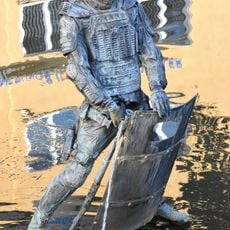
The Haarmannsbrunnen is a bronze fountain featuring a shirtless miner in work trousers, gripping hammer and ore as part of his labor. The sculpture stands at Herrenteichswall and captures realistic details of mining work.
The Haarmannsbrunnen was inaugurated on 1 May 1909, funded by Senator August Haarmann, general director of the Georgs-Marien-Bergwerks- und Hüttenverein. Sculptor Adolf Graef, who had studied under Auguste Rodin in Paris, made the bronze miner. The ceremony was not publicly announced and no workers were invited; the 1893 Stüveschacht accident that killed nine miners was not mentioned, and a link to it is not documented.
The miner holds hammer and iron although pneumatic drills were already in use in 1909, and water pours over him because he has struck a water vein — underground, a flooding like this meant mortal danger. August Haarmann, himself trained as a miner, wanted a powerful worker rejoicing at the spring he has drilled.
The fountain sits near the city center and remains freely accessible year-round without restrictions on visiting. The pathways around the statue are flat and easily reached on foot.
The miner holds a hammer and iron although compressed-air drills were already in use in 1909, and the water pouring over him marks a struck water vein — underground, a flooding that meant mortal danger. The tunnel behind him is cast from Durilit, an artificial stone made from Piesberg rock dust.
The community of curious travelers
AroundUs brings together thousands of curated places, local tips, and hidden gems, enriched daily by 94,552 contributors worldwide.