Haus Tenge, Architectural heritage monument in Osnabrück, Germany
Haus Tenge is a classicist building in Osnabrück featuring symmetrical window rows, balanced proportions, and ornamental stone details across its street facade. The structure displays carefully articulated wall surfaces and handcrafted facade elements typical of this architectural style.
Ernst Friedrich Tenge built the house in 1813–1814 on the Krahnstraße, opposite Osnabrück's town hall, merging plots Krahnstraße 1 and 2 and keeping a rear stone structure. Three generations of the Tenge family lived and traded here until 1879, when it passed to Abraham and Levy David, who ran the Samson David clothing business and added ground-floor shop windows. During the Nazi era Otto David was forced to sell to the city; he survived a concentration camp and recovered the house after the war, selling it in 1960.
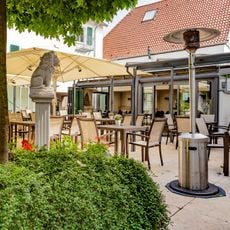
The building's name recalls the Tenge family, who lived and traded here for three generations until 1879. Its banquet hall, the only surviving one in a classicist house in Osnabrück, later held works by painter Markus Lüpertz when the restaurant "la vie" occupied the house from 2002. A Stolperstein laid by Gunter Demnig on 30 March 2008 in front of the building commemorates Gertrud David, born 1898, deported in 1940 and murdered in the Brandenburg killing centre.
The building is visible from outside throughout the year since it sits on a main street in the city center. For deeper information about its architecture, you can contact the Osnabrück Tourism Office, which occasionally offers guided tours.
The sandstone facade was painted with oil paint, which helped preserve it. The central section is decorated with four pilasters, and above the entrance hangs a laurel festoon, a laurel wreath interwoven with palm branches, beneath the middle window.
The community of curious travelers
AroundUs brings together thousands of curated places, local tips, and hidden gems, enriched daily by 93,779 contributors worldwide.