Waterloo-Tor, War memorial gate in Osnabrück, Germany
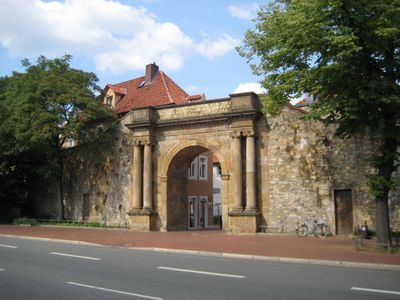
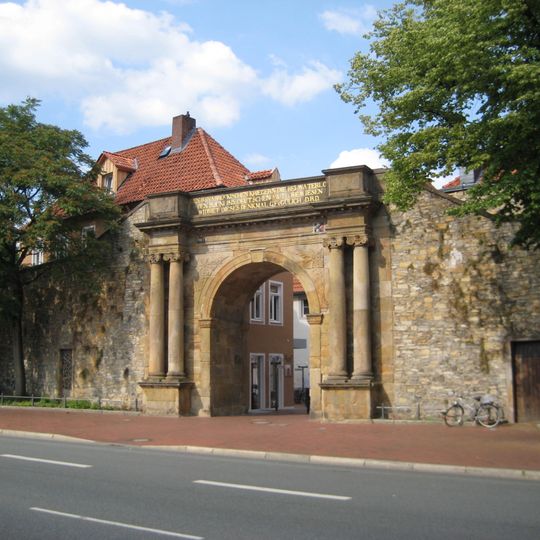
The Waterloo-Tor is a classical triumphal arch with ionic columns that combines the functions of a city gate and a war memorial. The structure features different architectural designs on each side and marks an important point in the urban landscape.
On 18 June 1815 soldiers from Osnabrück fought at Waterloo in the city's Landwehr battalion, light field battalion and the King's German Legion under British command. In 1816 the lawyer Gerhard Friedrich von Gülich donated 1,000 thalers for a memorial, and Johann Christian Sieckmann (1787–1861) designed the gate, built in 1817 on the Heger-Tor-Wall. Parts of the medieval Heger Tor, demolished in 1815, were incorporated into it.
Locals call the gate "Heger Tor" and rarely use the name "Waterloo-Tor". The architrave bears a gilded inscription in capital letters dedicating the monument to the Osnabrück fighters who showed German courage at Waterloo on 18 June 1815, signed G.F.v.Gülich D.R.D., where D.R.D. stands for Der Rechte Doktor, Gülich being a doctor of law.
The monument is located in the Heger-Tor neighborhood and is easily accessible on foot. Visitors can view it from both sides to see the different architectural treatments.
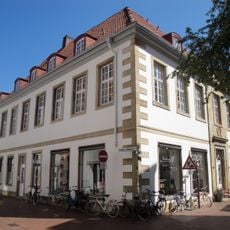
The old Heger Tor stood about 20 metres west of today's Waterloo-Tor, not east. The surviving Akzisehaus, once attached directly to the medieval gate, now sits across the Wallring, which shows where the old gate line ran. Locals still call the 1817 memorial "Heger Tor".
The community of curious travelers
AroundUs brings together thousands of curated places, local tips, and hidden gems, enriched daily by 93,951 contributors worldwide.