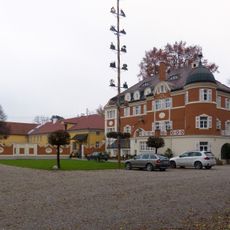
Hochablass, Water management structure in Augsburg, Germany.
Hochablass is a weir structure in Augsburg that diverts water from the Lech River into multiple canals and forms the core of the city's water management system. The facility consists of several components working together to control water flow and supply different parts of the city.
A weir at this site is documented in 1346; a plaque claims a first diversion in 1000, though this is unverified. Water rights disputes with the Bavarian dukes led to the "Wasserkrieg" of 1596, when 250 workers and 160 marksmen removed Bavarian bank works. The buildings were burned in 1634 and destroyed in 1703; the present reinforced-concrete weir, 145 m long, was rebuilt in 1911/12 by city building director Otto Holzer.
The name Hochablass refers to the 'high discharge' that feeds the Hauptstadtbach, the canal carrying Lech water into Augsburg's old town, where it runs through the Lechviertel alongside the Lochbach. The weir has been part of the Augsburg water management system inscribed on the UNESCO World Heritage List on 6 July 2019. The western bridgehead carries plastic sculpture by Josef Köpf showing a raftsman and a spinner with spindle, cornucopia and turbine wheel.
The site sits along Oberländer Straße and is accessible from paths running beside the Lech, which are open for walking and biking. Visitors should know this is an active working facility, and the best views of water flow are possible from different vantage points around it.
The Eiskanal whitewater course beside the weir was built for the 1972 Munich Olympics, where the canoe slalom events were held. Water is diverted from the Lech through the course, and its concrete banks and obstacles remain in use for training and competitions.
The community of curious travelers
AroundUs brings together thousands of curated places, local tips, and hidden gems, enriched daily by 94,607 contributors worldwide.