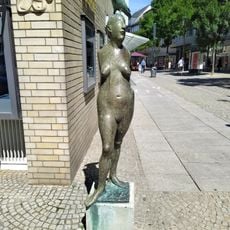
Huckup, Sculpture in Hildesheim, Germany
Huckup is a bronze sculpture in Hildesheim depicting two figures: a supernatural being perched on the shoulders of a young man carrying stolen apples in a sack. The composition shows the moment when the creature punishes the wrongdoer.
The Dresden sculptor Carl Röder made the Huckup in 1905 for the corner of Schuhstraße and Hoher Weg. The figure draws on two Hildesheim legends recorded by Karl Seifart, one from the Ziegenberg near Söhre and one from the Itzumer Holz. The older motif of the Aufhocker, linked in folklore research to the walking dead, was recast here as a moral warning to thieves.
The name Huckup comes from Low German for "hock up" (sit on). Karl Seifart recorded two Hildesheim legends, one from the Ziegenberg near Söhre and one from the Itzumer Holz. The sculptor turned the eerie Aufhocker into a kobold embodying a bad conscience, who jumps on the backs of thieves.
The monument stands at the corner of Schuhstraße and Hoher Weg, at the southern end of Hildesheim's pedestrian zone, so it is passed on foot rather than approached by car. It is a freestanding sculpture on a base at street level, with no ramp or special access installation; the surrounding pedestrian area is level and paved.
The base contains verses warning against apple theft and connects the work to local agricultural customs. These inscriptions show how the sculpture conveyed moral lessons from everyday life.
The community of curious travelers
AroundUs brings together thousands of curated places, local tips, and hidden gems, enriched daily by 94,630 contributors worldwide.