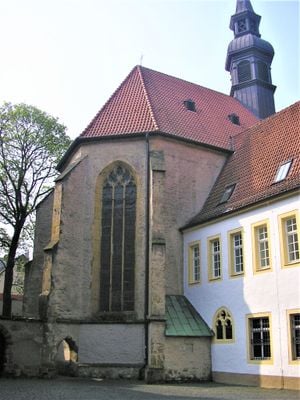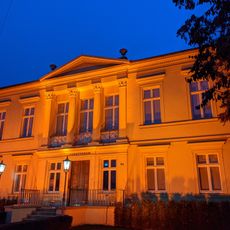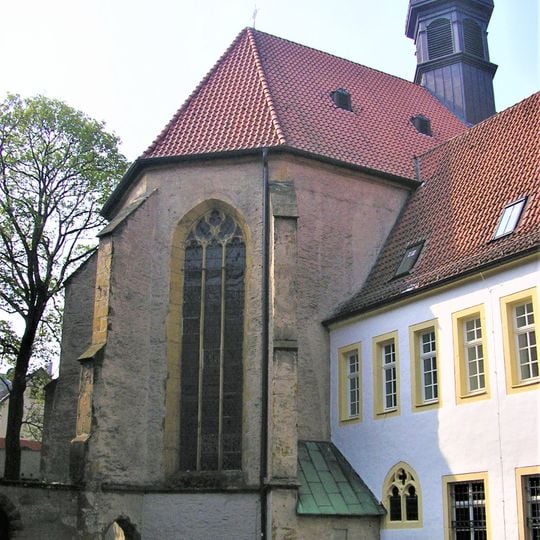
St. Jodokus, Gothic church in Bielefeld, Germany.
St. Jodokus is a late Gothic hall church with five bays, side niches and a single-bay choir ending in a 5/8 polygon. It has no tower, only a roof turret with four bells, and a plain west facade. The south portal from 1713 opens onto Obernstraße.
Franciscans founded a house on the Jostberg in 1498 and moved it into Bielefeld in 1507 because of water shortages there and to live among townspeople. The new church's choir was consecrated on 18 July 1511, the rest in 1515 by Paderborn auxiliary bishop Johannes Schneider, a Franciscan. The convent survived the Reformation as a Catholic base and was dissolved by Prussian authorities in 1829.
The church is dedicated to Saint Jodokus, a 7th-century hermit and pilgrim from northern France. Since 1921 the Corpus Christi procession has started from St. Jodokus and passed through the old town. Today the parish shares the church and former convent rooms with the Catholic university chaplaincy and the CityKloster city pastoral centre.
The location sits centrally in Bielefeld and is walkable from the main streets of the old town. Visitors should check for open times upon arrival, as the church may have limited access for tourists during services or events.
St. Jodokus has no tower, following the Franciscan ideal of poverty; instead a roof turret carries four bells above the nave. The vault's dry-painted decoration is dated 1511, and an oriel on the former convent buildings bears the year 1515. The south portal to Obernstraße, the baroque Von Consbruch portal, dates from 1713.
The community of curious travelers
AroundUs brings together thousands of curated places, local tips, and hidden gems, enriched daily by 93,825 contributors worldwide.