Crüwell-Haus, Architectural heritage monument in Old Market, Bielefeld, Germany
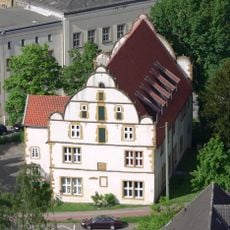
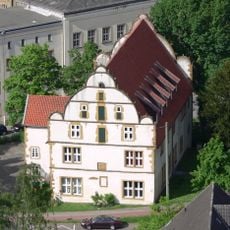
The Crüwell-Haus is a heritage monument at the Old Market in Bielefeld, featuring a four-part stepped gable made of sandstone that rises five stories above its two-story base structure. The facade displays crafted details, and the interior preserves important historical room furnishings.
The house was built around 1530, dated by an inscription once in a cellar column. In 1813 the Crüwell family bought it for 2,570 gold thalers and set up a smoking-tobacco factory; a horse-driven Göpel installed in 1826 cut pipe tobacco and ground snuff. Production ended in 1983 for lack of profitability, but a tobacco shop opened in a Piggenstraße annex in 1985.
About 7,000 Delft tiles from the 16th to 18th centuries line the staircase on the Piggenstraße and one sales room. They come from the collection of the merchant Richard Mitzlaff-Crüwell and form probably the largest collection of its kind in northwestern Germany. The tiles were made in the Netherlands and show biblical and floral motifs.
The building stands at the intersection of Obernstraße and Old Market Square, making it easy to find as a central landmark in the historic city center. Its distinctive stepped gable shape helps identify it from different angles.
The gable was not spared in the war: the bombing of 30 September 1944 burned the house out to its outer walls, and the stepped gable had to be largely renewed in sandstone during its 2005 restoration, supported by the Deutsche Stiftung Denkmalschutz. The two coats of arms in the lowest gable field honour Johan Grevin and Arnold Crüwell, who led the firm from 1867 to 1935.
The community of curious travelers
AroundUs brings together thousands of curated places, local tips, and hidden gems, enriched daily by 92,727 contributors worldwide.