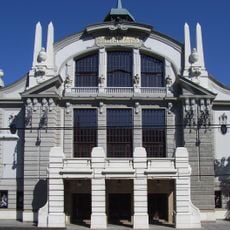
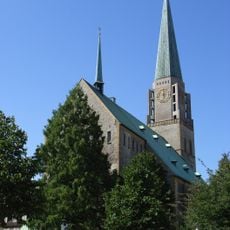
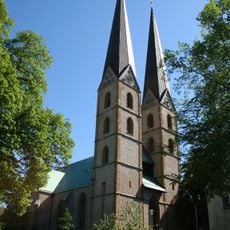
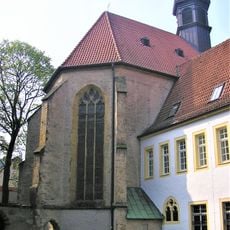
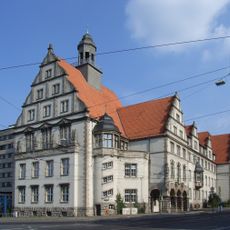
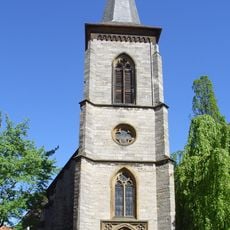
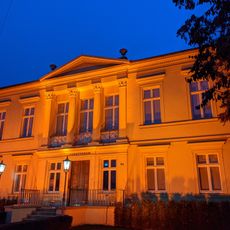
Synagogue in Bielefeld, Synagogue in Bielefeld, Germany.
The Synagogue in Bielefeld is an early 20th-century building with distinctive architectural features characteristic of that period. Its interior was designed to accommodate approximately 800 people in the main prayer hall for worship and gatherings.
The Old Synagogue was built in 1904/05 to a design by Eduard Fürstenau, who won the 1902 competition with a Neo-Byzantine scheme; the foundation stone was laid on 18 May 1904 and the building was inaugurated on 20 September 1905. It replaced the 1847 synagogue on Klosterplatz, which had become too small for a community of over 1,100 members. During the November pogrom on the night of 9–10 November 1938, National Socialists looted and set fire to the synagogue; the ruin was demolished from November 1939.
The community that built the synagogue had over 1,100 members in 250 households, and high-holiday services had long been held in rented rooms because the 1847 synagogue at Klosterplatz was too small. The new building seated 450 men and 350 women, and its Torah curtain was woven by Bielefeld artist Gertrud Kleinhempel.
The site is located in Bielefeld's city center and can be reached on foot from downtown. It helps to check in advance whether visits are possible at certain times or if guided tours are available.
The burning synagogue was filmed by amateur filmmaker Gustav Wittler; his footage is one of the few surviving films of a synagogue on fire during the November pogroms of 9 November 1938 and is shown at the Jewish Museum Berlin and the United States Holocaust Memorial Museum. Colour slides of the burning dome were taken by hobby photographer Hans Asemissen, who lived nearby on Turnerstraße.
The community of curious travelers
AroundUs brings together thousands of curated places, local tips, and hidden gems, enriched daily by 92,641 contributors worldwide.